A new NVIDIA-Amkor agreement is another reminder that AI hardware capacity is not only a wafer-fab story. Evertiq reported that Amkor Technology entered a multi-year agreement with NVIDIA worth USD 1.5 billion to develop advanced semiconductor packaging and test technologies for next-generation AI and accelerated computing platforms. The same report says the companies will align long-term roadmaps around high-density interconnects and next-generation heterogeneous integration.
For electronics buyers, the practical point is narrower than the headline. This is a roadmap and capacity signal for the back end of semiconductor manufacturing. It does not mean every AI-adjacent integrated circuit, memory device, power part, connector, or passive component becomes easier to source this quarter. It does mean sourcing teams should keep advanced packaging and test capacity on the same watchlist as fabs, memory, substrates, and board-level power delivery.
The signal: packaging and test are moving closer to AI platform roadmaps
The Yahoo Finance version of Amkor’s announcement says NVIDIA will provide a prepayment to support expansion of Amkor’s U.S. advanced packaging capacity. It also says advanced packaging enables the performance, energy efficiency, and system-level integration required for AI infrastructure. Those words matter because they describe packaging as part of the platform roadmap, not a final assembly detail that can be solved late in the schedule.
SemiMedia added a useful caution: the companies did not disclose the agreement’s exact duration, annual purchasing volumes, or accounting schedule for the prepayment. That keeps the buyer takeaway disciplined. The public signal supports a conclusion that AI infrastructure customers are trying to align future packaging and test capacity more tightly. It does not support a conclusion that a specific component family has immediate relief, a specific lead-time change, or a guaranteed price path.
What this means for PCX buyers
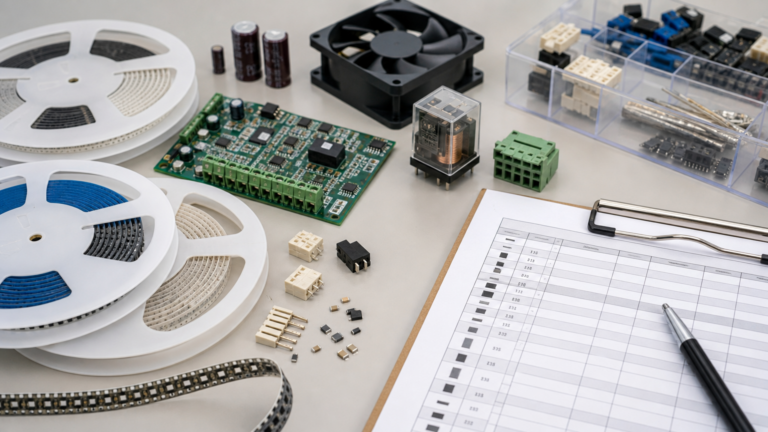
Most PCX customers are not buying advanced packaging capacity directly. They are buying board-level electronics: integrated circuits, memory-adjacent devices, power management ICs, discretes, connectors, passives, thermal hardware, and the hard-to-find items that sit around larger systems. A packaging agreement can still matter to those buyers because constraints at one layer often change behavior at another layer.
When AI platforms pull more attention toward high-density interconnects and heterogeneous integration, suppliers may prioritize engineering resources, package roadmaps, test capacity, substrate choices, and qualified lanes around the highest-volume or highest-margin programs. That can leave non-AI industrial, networking, medical, aerospace, or embedded buyers with less clear visibility even when they are purchasing more ordinary components. The risk is not that every part becomes scarce. The risk is that planning assumptions become stale while the supply base is reorganizing around AI infrastructure.
Do not translate the headline into automatic availability relief
Capacity announcements can create a false sense of timing. A buyer may see a large agreement and assume that constrained components will be easier to source soon. That is not a safe reading here. The public reports describe long-term roadmap alignment, U.S. capacity expansion, and advanced packaging and test development. They do not provide an immediate availability schedule for specific MPNs on active BOMs.
The better response is to use the announcement as a prompt for a targeted review. Which programs depend on AI-adjacent processors, networking ICs, high-bandwidth memory ecosystems, power modules, high-current connectors, precision passives, heatsinks, or fans? Which items have single-source exposure, tight approval windows, or customer-controlled alternates? Which parts need documented chain-of-custody or extra inspection if the team has to buy outside normal distribution?
What to review in the BOM file this week
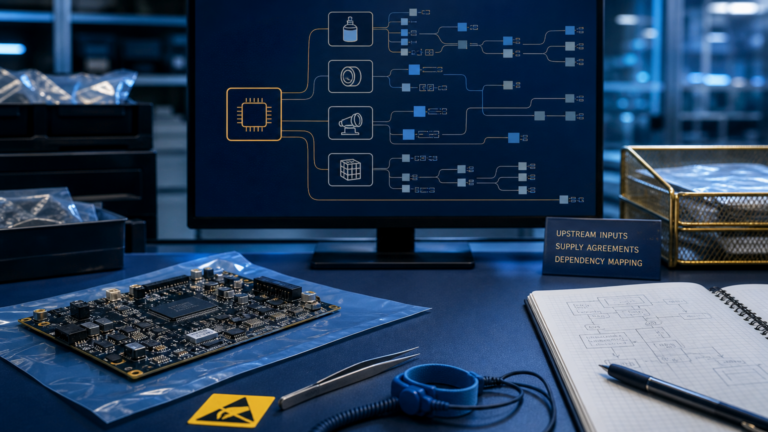
Start with the parts that are hard to substitute. For each exposed item, record the exact MPN, package, date-code requirements, lifecycle status, approved alternates, and the next production demand window. Then separate the risk into three buckets: availability risk, price risk, and quality or traceability risk. A component can be available but unattractive on price; it can be competitively priced but exposed to counterfeit risk; or it can be technically substitutable but blocked by customer approval.
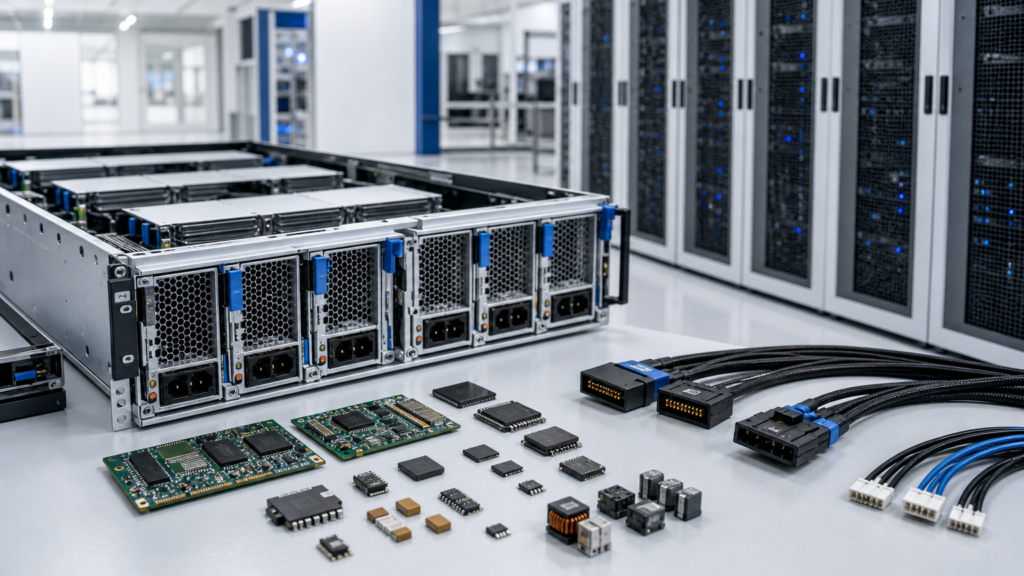
For AI infrastructure or high-power boards, also review supporting categories that are easy to overlook: DC-DC conversion, MOSFETs, protection devices, high-current connectors, board-to-board connectors, MLCCs, tantalum capacitors, inductors, thermal interface materials, heatsinks, and fans. PCX covered a related board-level angle in its power and thermal BOM review for AI infrastructure. The sourcing question is not only whether the headline part is available. It is whether the surrounding board can be built repeatedly without late substitutions.
Where PCX fits
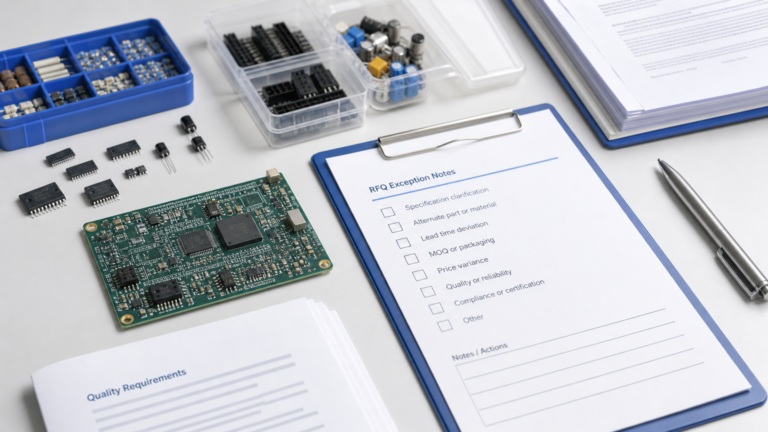
PCX can help buyers translate capacity headlines into a concrete sourcing file. That means reviewing exact MPN exposure, checking availability across trusted channels, comparing alternates, and documenting what evidence is needed before a hard-to-find buy. For teams already seeing quote volatility or schedule pressure, the strongest next step is to send PCX an RFQ with quantities, required dates, acceptable alternates, and any quality documentation requirements.
The disciplined reading of the NVIDIA-Amkor news is simple: advanced packaging is becoming more strategic to AI platform supply, and buyers should not wait for that pressure to reach the board-level BOM before reviewing exposure. Treat the agreement as a planning signal, not a promise of near-term supply relief.
Sources and further reading
- Nvidia, Amkor sign $1.5 billion chip packaging agreement, Evertiq, July 24, 2026.
- Amkor Technology Announces Strategic Partnership with NVIDIA to Expand Advanced Packaging and Test for Next-Generation AI Infrastructure, Yahoo Finance / Business Wire, July 23, 2026.
- NVIDIA provides $1.5 billion prepayment to expand Amkor’s U.S. AI packaging capacity, SemiMedia, July 24, 2026.