A production build can look covered when the main ICs are allocated, quoted, or already on order. That does not mean the rest of the board-level BOM is safe. Interconnect, passive, and electromechanical lines often carry their own lifecycle, documentation, and sourcing constraints, and those constraints can become more visible only after a buyer is already close to the final purchase order.
Recent Electronics Sourcing articles give buyers a useful reminder. One article on obsolescence and end-of-life challenges says downstream supply-chain teams face EOL notifications, longer lead times, and redesign cycle times as suppliers reshape manufacturing capacity and product portfolios. A separate obsolescence article describes a market where lifecycle risk is not only age-based; economics, geopolitical volatility, wafer allocation priorities, and technology transitions can also affect whether a component remains commercially obtainable. A third article on testing and standards connects EOL notices and shortage stress to counterfeit-risk discipline.
What this means for PCX buyers
For PCX buyers, the takeaway is practical rather than dramatic: IP&E lines should be reviewed before the final buy, not after the semiconductor shortage has already consumed the schedule. If a BOM includes passive components, connectors, or electromechanical components with customer approval boundaries, the risk review belongs in the sourcing file before urgency compresses the decision.
Why IP&E still needs attention
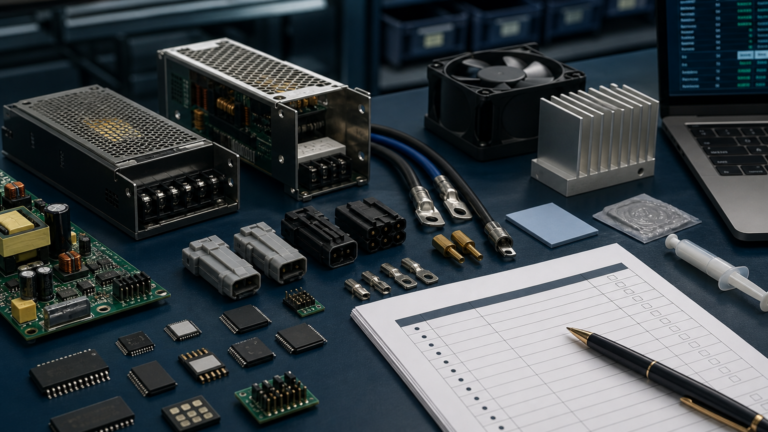
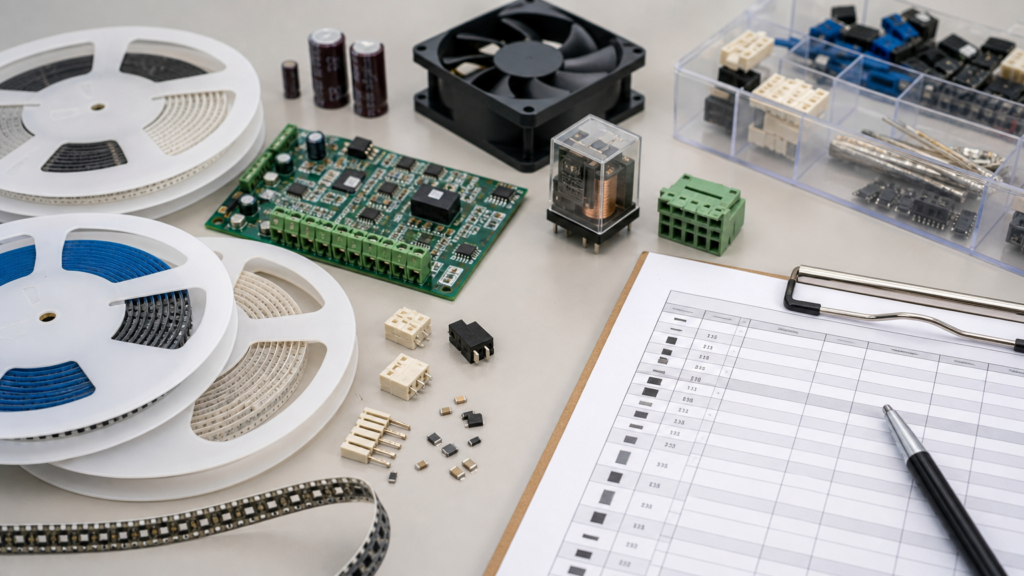
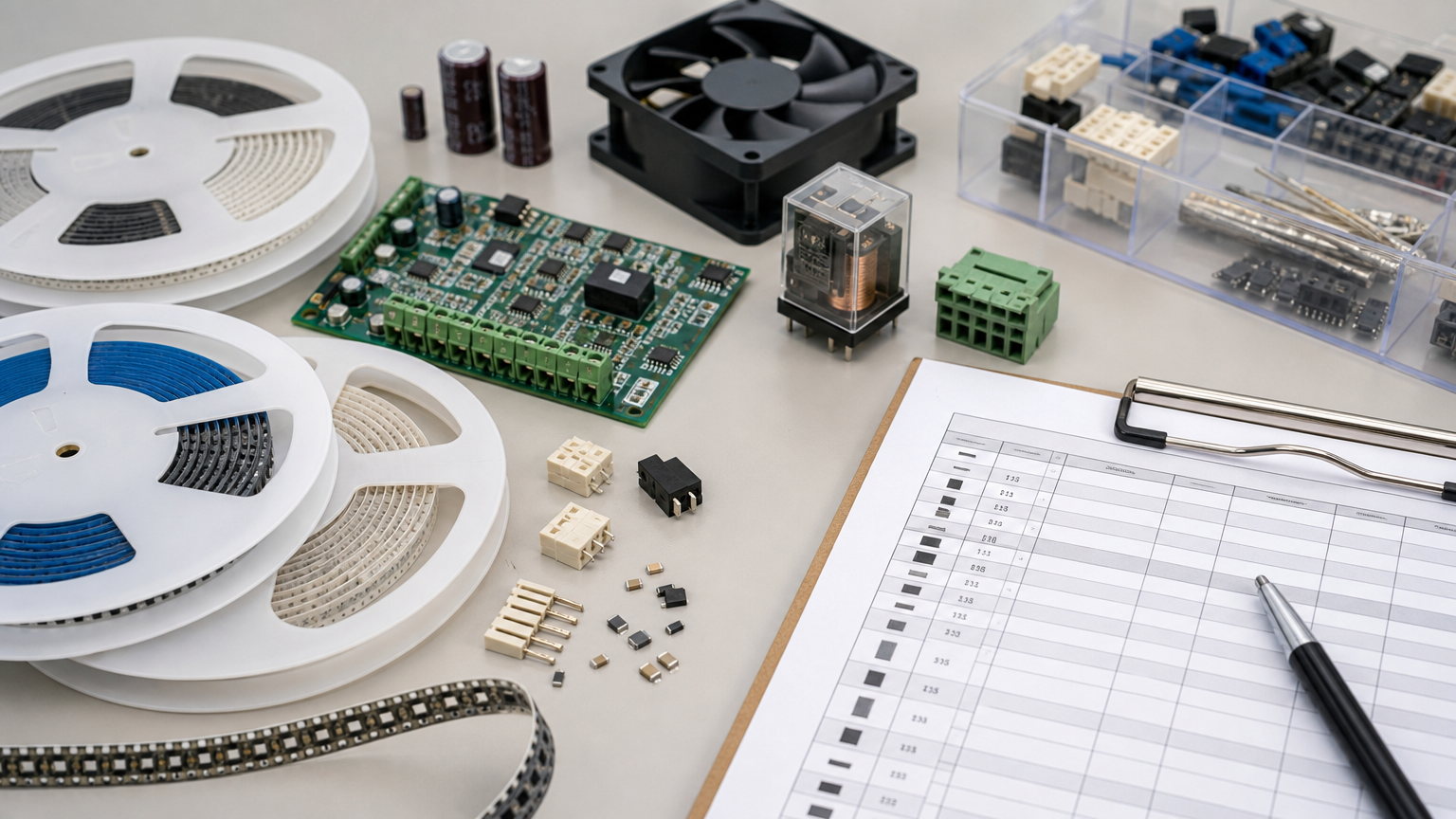
IP&E is easy to underestimate because many of these parts are physically familiar and less visible than processors, memory, FPGAs, or power-management ICs. But a missing connector, relay, film capacitor, inductor, switch, fan, power supply, or thermal part can still hold the finished assembly. Some parts are application-specific. Some carry agency, environmental, or customer approval boundaries. Others depend on package, mounting, voltage, tolerance, temperature, mating, or mechanical fit details that do not travel cleanly in a short MPN list.
The buyer risk is not that every IP&E family is constrained at once. The risk is that a line item assumed to be routine may have an EOL notice, narrowing inventory depth, long qualification path, or documentation requirement that only appears after purchasing asks for an urgent quote. That is the moment when teams are most tempted to accept a quick substitute without enough evidence.
Run the lifecycle check by exact line item
A useful IP&E review starts with exact MPNs, approved manufacturers, customer-approved alternates, and known no-substitution notes. Then the sourcing team should ask a simple question for each part family: what would make this line difficult to replace if the named part is unavailable?
For passives, the answer may involve capacitance, tolerance, voltage, dielectric, ESR, ripple-current assumptions, case size, temperature rating, or prior qualification. For connectors, it may involve mating interface, shell, plating, ingress rating, pin count, backshells, cable assemblies, or installation materials. For relays, switches, fans, heatsinks, and power supplies, the risks may include load rating, thermal margin, mechanical envelope, regulatory file, acoustic limits, or field-service approval. None of those details proves a shortage. Each detail determines whether a substitute is actually usable.
Do not let EOL turn into a blind spot
The Electronics Sourcing obsolescence coverage is useful because it frames EOL as a continuity-planning problem, not just a purchasing event. If a supplier issues an end-of-life notice, the buying team may still have options: last-time buy review, approved alternate search, redesign support, or controlled inventory planning. Those options shrink when the review starts after the final build quantity is already committed.
Buyers should separate three questions. First, is the requested part still active and commercially obtainable through acceptable sources? Second, if it is not, is there a documented approved alternate or only a parametric lookalike? Third, if the team must use an independent or open-market path, what evidence will be required before the material can be accepted into production?
Counterfeit avoidance belongs in the same review
Shortage and EOL conditions should raise verification discipline. Electronics Sourcing’s testing-and-standards article discusses AS5553 supplier evaluation, traceability to the original component manufacturer, inspection and test protocols, flow-down requirements, and quarantine/reporting practices for suspect material. The same article also describes AS6171-related test methods such as packaging and documentation review, external visual inspection, X-ray and XRF analysis, and electrical characterization.
That does not mean every routine IP&E purchase needs the same test plan. It does mean buyers should decide the acceptance evidence before urgency takes over. At minimum, a sourcing file should capture traceability expectations, date-code or lot constraints, packaging and label checks, datasheet and certification needs, and any customer or quality-system approval boundaries.
What to send with the RFQ
The safest RFQ is not the longest one. It is the one that tells the sourcing partner which limits matter. For an IP&E lifecycle review, buyers should include the current MPN, manufacturer, approved alternate list, annual or build quantity, target delivery window, end-customer restrictions, known lifecycle notices, and any electrical, mechanical, thermal, agency, or environmental constraints. If a line is build-critical, say so. If substitutions are not allowed without engineering approval, say that too.
PCX can help buyers review passive components, connectors, electromechanical parts, and related board-level lines by exact MPN, available source path, documentation package, and risk tolerance. The goal is not to promise that every part is available. The goal is to make the sourcing decision specific enough that urgency does not hide lifecycle or counterfeit risk.
Sources and further reading
- Obsolescence and end-of-life challenges, Electronics Sourcing, July 7, 2026.
- Bridging the obsolescence gap, Electronics Sourcing, July 7, 2026.
- Reducing electronic component risk with advanced testing and standards, Electronics Sourcing, July 7, 2026.