

Legacy memory does not need to be glamorous to create sourcing work. Recent reporting from TrendForce says prices for certain MLC NAND categories have risen sharply as suppliers move away from older 2D NAND products. A separate ADATA Industrial market watch also points to strong NAND and DRAM price pressure while noting Kioxia planned discontinuation of several legacy NAND product types.
For buyers, the practical issue is not a headline shortage across every memory line. It is narrower: board-level products that still specify older NAND generations, memory-bearing modules, industrial controllers, repair programs, and long-life equipment may need a lifecycle-file review before existing assumptions about availability are carried into the next buy.
What this means for PCX buyers
The signal is a reminder to separate high-volume mainstream memory from the older devices still present in long-life designs. If a board uses NAND flash, memory ICs, controllers, storage modules, or embedded assemblies with legacy part numbers, the sourcing file should identify alternates, approved manufacturers, last-time-buy exposure, and whether scheduled orders cover the program window.
Pacific Component Xchange supports that kind of review by helping teams source hard-to-find board-level components, compare approved alternatives, and document quality and traceability expectations before urgency forces a spot buy. When a memory line is already constrained or obsolete, a clean RFQ with manufacturer part numbers, date-code needs, packaging, quantity breaks, and target delivery windows gives sourcing teams a better chance to separate real availability from noise. Buyers can start that conversation through the PCX request a quote form.
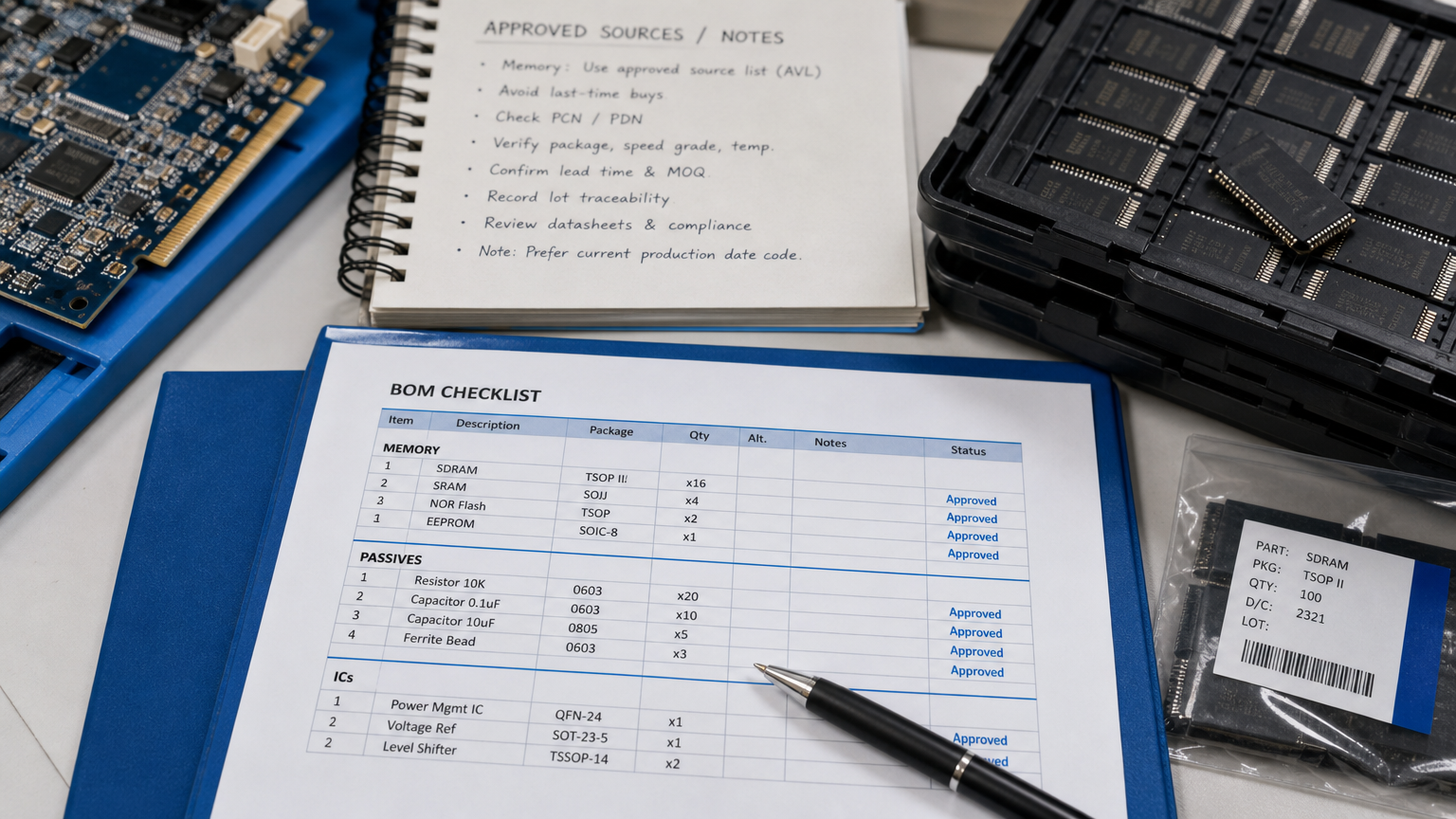
The source signal
TrendForce reported that MLC NAND spot prices have tripled since late 2025 and connected the move to supply being squeezed as suppliers exit legacy NAND categories. The same report specifically frames the pressure around older MLC products used in areas such as vehicle navigation and home appliances, rather than treating it as a uniform signal for all memory devices.
ADATA’s market update points in the same direction from a vendor-market perspective: it highlights a Q2 surge forecast for NAND and DRAM and notes Kioxia discontinuation of 2D NAND products, including SLC, MLC, and TLC families across several legacy process nodes. Because ADATA is a market participant, PCX treats that update as a supporting signal rather than a neutral forecast. It is useful context, but it should not be read as a guarantee about any specific part number.
Component families to check
The first pass should focus on BOM lines where an older memory technology is specified exactly and where qualification history limits substitution. That can include discrete NAND flash, managed NAND modules, storage daughtercards, embedded controllers, industrial HMIs, test equipment, older communications products, and repair or sustaining-engineering programs that still rely on older board-level assemblies.
Buyers should also check adjacent integrated circuits and power-management components if the memory device is tied to a board redesign or alternate module qualification. A memory substitution can change firmware assumptions, controller compatibility, packaging, thermal behavior, or board-layout constraints. The purchasing question is therefore not just whether a part can be found today; it is whether the approved sourcing path remains usable for the next production or service window.
What is stable versus tightening
The available public sources do not support a blanket claim that every NAND device is in shortage. The clearer signal is that older MLC and 2D NAND categories deserve closer attention because some suppliers have shifted focus toward newer technologies and higher-volume markets. That distinction matters. A current-production memory IC may have routine distribution coverage while a legacy-qualified device on a service BOM becomes harder to source.
A practical review should split the list into three groups: parts with healthy authorized availability, parts that require scheduled orders or alternates, and parts where lifecycle or obsolescence risk is already visible. For each risk item, buyers should ask whether the program can qualify a replacement, whether an approved source list exists, and whether traceability requirements are documented before a constrained buy begins.
Forecast and sourcing questions
- Which BOM lines specify MLC NAND, 2D NAND, managed NAND, or memory modules that cannot be substituted freely?
- Do current forecasts cover sustaining production, warranty, and repair demand, not just new builds?
- Are last-time-buy notices, product change notices, or end-of-life notices attached to the sourcing file?
- Can engineering approve a second source, or is the original memory device tied to firmware and qualification limits?
- What date-code, packaging, inspection, and documentation requirements must be preserved if open-market sourcing is needed?
Quality and traceability discipline
Legacy memory pressure can create a wider spread between real inventory, broker inventory, and listings that require additional verification. That does not mean buyers should avoid the open market altogether. It means the sourcing process needs clear inspection expectations, supplier vetting, and documentation before purchase commitments are made.
For sensitive, obsolete, or hard-to-find memory lines, PCX buyers should keep quality requirements visible from the first RFQ and treat the lifecycle file as a purchasing control, not an engineering archive. PCX’s quality and traceability process is relevant when teams need to manage supplier risk, documentation, and counterfeit-avoidance expectations around constrained components.
PCX buyer takeaway
The near-term action is narrow and distinct from broader AI-memory coverage: build or refresh a lifecycle file for each older NAND-bearing assembly before the next purchase window. If the BOM contains older NAND or memory-bearing assemblies, check lifecycle status, confirm approved substitutes, and align scheduled orders with real build and service demand. The best time to resolve a legacy memory sourcing issue is before the line item becomes an emergency buy.