

ECIA’s new IEEPA tariff-refund guidance is a reminder that policy headlines do not all hit electronics buyers the same way. The practical filter is to separate refund exposure, documentation work, supplier eligibility, and real BOM availability risk.
Export-control and tariff news can trigger the same unhelpful reaction inside a sourcing organization: assume the headline affects every semiconductor buy at once. ECIA’s latest advisory on IEEPA tariff refunds is a better reminder of how these issues usually work. The impact is specific. It depends on what was imported, when it entered, which duties applied, how the transaction was documented, and where funds still need to move through the chain.
For component buyers, that means the first question is not “Is this big news?” It is “Which part of our buying process does this actually touch?” In many cases, the immediate issue is paperwork and financial timing, not sudden board-level unavailability.
What changed this week
ECIA says its new advisory is meant to help electronics supply-chain customers navigate tariff rebates after the Supreme Court ruling on IEEPA-authorized tariffs. Just as important, ECIA also says buyers should not assume that every duty in play is now refundable. Its guidance states that Section 301 and Section 232 duties remain in effect and are not part of the refund relief described in the advisory.
That distinction matters because buyers often see the word “tariff” and assume one accounting treatment applies to everything. It does not. ECIA also warns that U.S. Customs and Border Protection’s CAPE system still has limitations for certain time periods and more complex entry types. In other words, even when a refund path exists, the process may still be slow, technical, and uneven across shipments.
Why this matters to electronics buyers now
Electronics Sourcing’s coverage of the advisory highlights the operational problem clearly: the refund process is not instantaneous. ECIA President and CEO David Loftus says the flow of funds moves through multiple stages, from government to manufacturers to distributors and then to customers. ECIA’s expectation is that reconciliation may extend into late Q3 or Q4 of 2026.
For a procurement team, that points to a finance-and-documentation issue before it points to a shortage issue. If a company is expecting immediate cash relief, the timing assumption may be wrong. If a buyer cannot clearly map affected entries, suppliers, and invoice paths, the administrative burden may become more significant than the original headline suggested.
Do not confuse tariff refunds with export-control exposure
This is also where buyers need a second filter. Tariff treatment and export-control treatment are related only in the broadest sense that both sit inside trade risk. They are not the same operational question. A refund advisory affects landed-cost recovery and documentation. Export-control scrutiny affects whether a part, technology, end use, or end user can move through the chain in the first place.
CSET’s explainer on U.S. semiconductor export policy remains useful here as a framework, even though the rule details have evolved since 2020. The core lesson is that controls can attach to specific items, technical data, end uses, or named entities rather than to every semiconductor transaction equally. For buyers, the practical signal is to narrow the review: is the issue tied to the exact integrated circuits on the BOM, to a supplier’s customer restrictions, or simply to post-entry financial administration?
A workable buyer risk filter
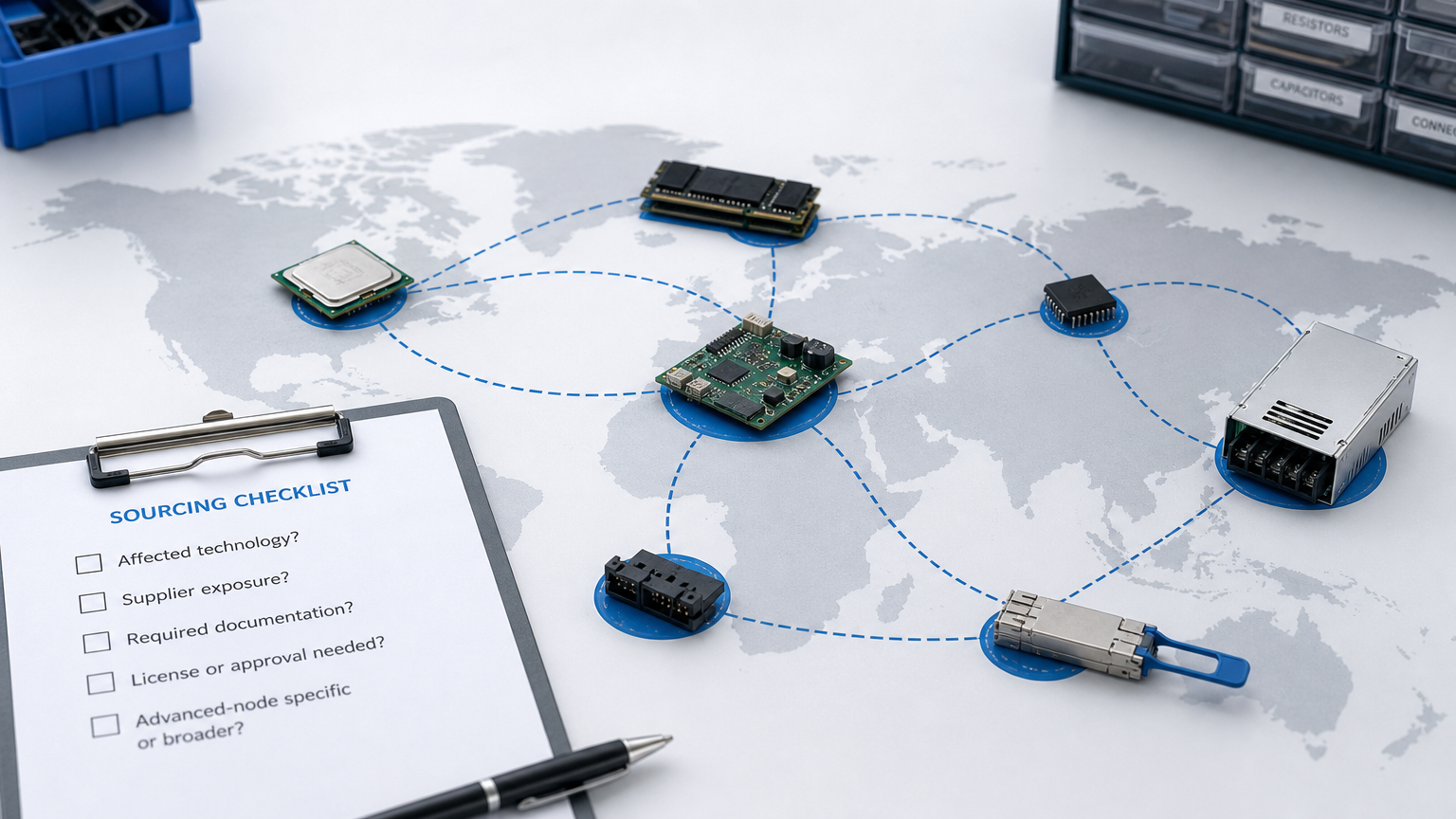
When a policy signal hits, the cleanest response is a short part-level review. Start with the exact MPNs and shipments that may be affected. Confirm which duty regime applied, whether the transaction falls inside the advisory’s scope, what supporting entry records are available, and whether any supplier-specific restrictions change the eligible source list.
- Identify the exact parts, purchase orders, and entry periods involved.
- Separate IEEPA refund exposure from Section 301 or Section 232 exposure.
- Confirm whether the issue is financial timing, documentation, or actual supply restriction.
- Ask suppliers what information they will require to support any downstream reconciliation.
- Review whether alternate suppliers would create new qualification or traceability work.
This kind of filter prevents two common mistakes: overreacting to a macro policy story, or underreacting because no immediate shortage is visible. Both mistakes cost time. One creates unnecessary buying noise. The other delays documentation and supplier conversations until the team is already behind.
Where PCX fits in the process
PCX’s role is not to replace legal or customs guidance. It is to help buyers translate policy-driven uncertainty into a narrower sourcing decision: which parts need attention, which supplier paths need review, and what verification or documentation discipline should stay attached to the order. When the situation raises traceability, inspection, or customer-flow questions, PCX’s certifications and memberships page is one place buyers can review the quality framework behind that discussion.
The immediate takeaway is simple. Do not let a broad export-control or tariff headline push the whole BOM into panic mode. Use a buyer risk filter, decide whether the issue is refund timing, compliance process, supplier eligibility, or true availability, and then act at the part level. If you need help reviewing exposed lines or alternate sourcing paths, request a quote with the affected MPNs and timeline.