
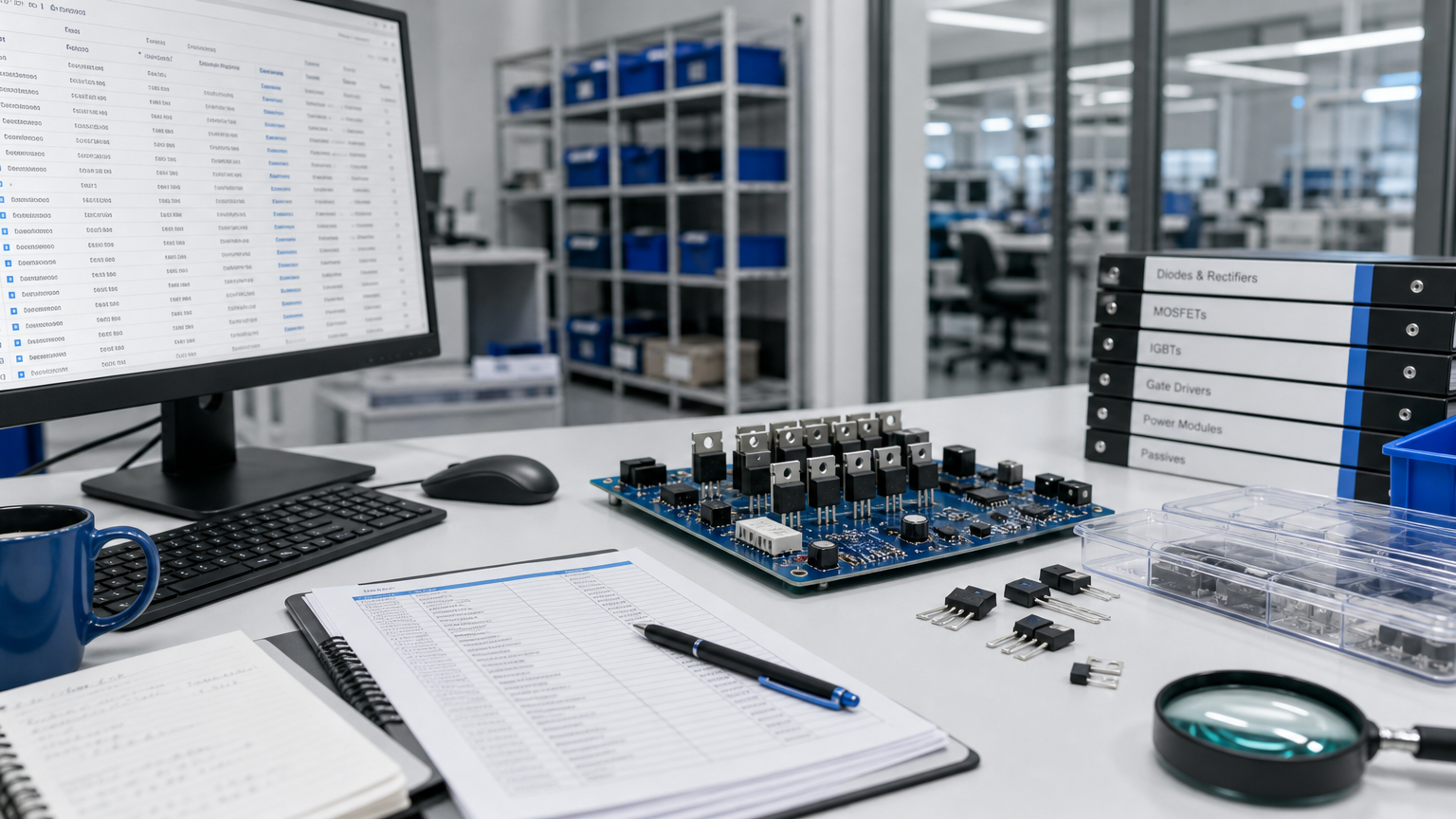
AI Power Demand Turns Power Semiconductors Into a BOM Exposure Check
AI infrastructure demand is usually discussed through GPUs, memory, and advanced packaging. For sourcing teams, the quieter signal can be the power path around those systems: power-management ICs, MOSFETs, diodes, gate-driver-adjacent devices, and other board-level power semiconductors that make dense compute practical.
Evertiq reported that Infineon raised its fiscal 2026 full-year guidance after second-quarter results, pointing to demand for power supply solutions for AI data centers and a recovery in automotive order intake. That is useful context, but it should not be converted into a blanket shortage call. The practical signal is narrower: buyers with power-heavy designs should know which parts of the BOM could be more exposed if AI infrastructure demand continues to compete for supplier attention.
What the Infineon signal does and does not say
The inspected public source is a supplier-guidance news item, not a distributor lead-time table. Evertiq says Infineon raised its outlook and ties the upgrade to AI data-center power-supply demand, while also noting improving automotive order intake. It does not, by itself, prove that a specific MOSFET, power-management IC, diode, controller, or module on an OEM BOM is constrained today.
That distinction matters because sourcing teams can lose time when a macro headline is treated as a part-level fact. A guidance update can show where demand is improving and where supplier capacity may receive attention. It cannot replace a live check of current availability, approved alternates, open orders, date-code requirements, quality documentation, and customer-specific consumption.
What this means for PCX buyers
For PCX buyers, the takeaway is to treat AI power demand as an exposure-review prompt. If a program depends on power management, analog, discrete semiconductors, or mixed automotive and industrial demand, the first step is not panic buying. It is a targeted review of which parts are single-sourced, which alternates are already approved, and which devices sit near production gates where a delay would be expensive.
That review should include board-level categories such as integrated circuits, power-management ICs, MOSFETs, diodes, transistors, and related discrete semiconductors. Teams can also check whether the design uses parts that are shared across data-center, automotive, industrial, and energy applications. When one component family serves several active end markets, the availability picture can change faster than the headline cycle.
Where to look on the BOM first
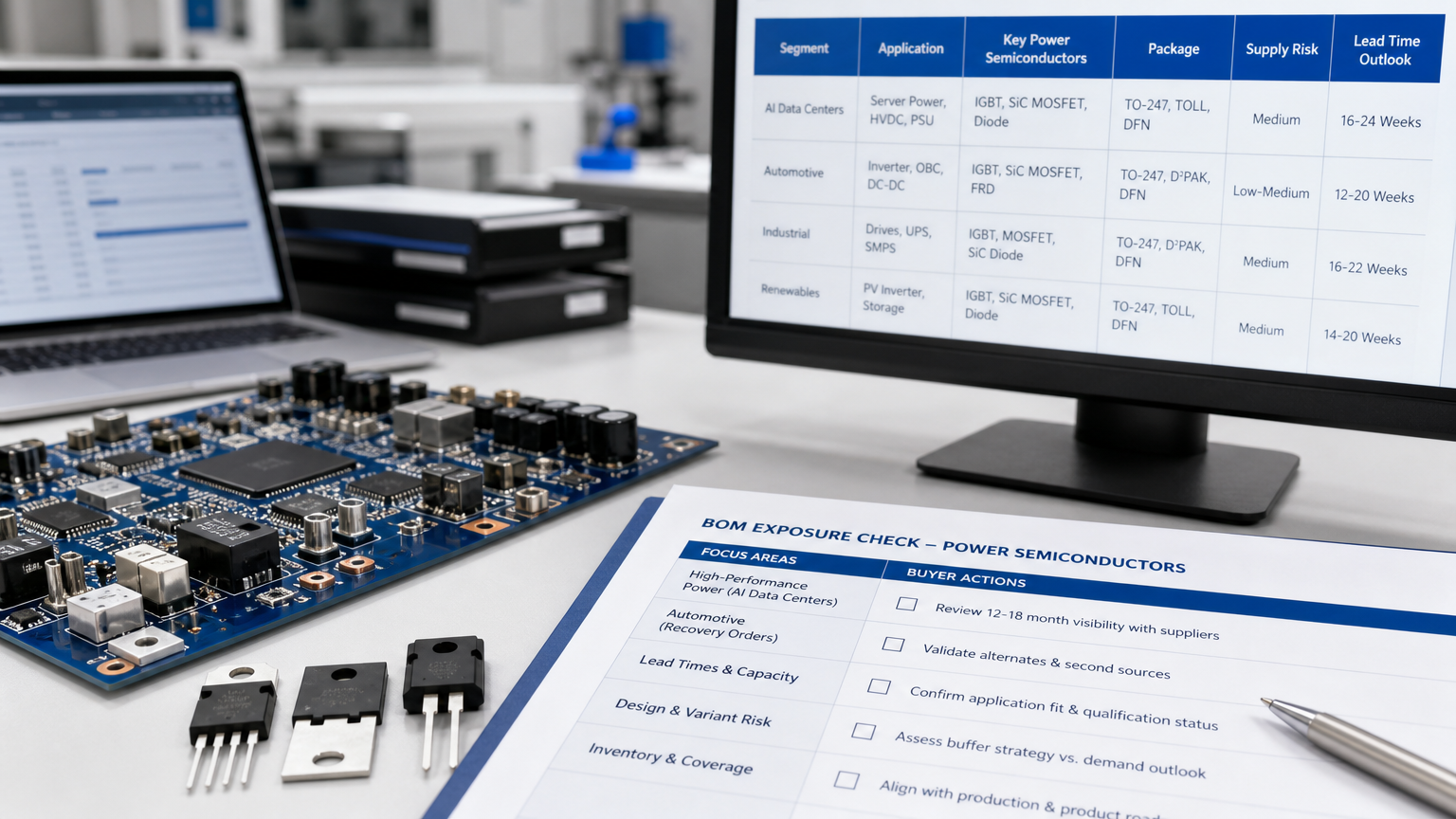
A useful PM-slot response is a focused BOM pass, not a market-wide conclusion. Start with power-path devices that have tight electrical, thermal, package, or qualification requirements. If a part has limited approved alternates, long requalification time, or a history of allocation behavior during demand spikes, it deserves earlier attention than a commodity item with several qualified substitutes.
- Power-management and analog ICs: confirm preferred manufacturer, package, temperature grade, and pin-compatible alternatives where engineering has already approved them.
- MOSFETs, diodes, and transistors: review voltage, current, thermal, package, and avalanche or switching requirements before assuming a cross-reference is equivalent.
- Automotive or industrial-qualified devices: separate commercial availability from qualification-ready availability; the sourcing option that exists on paper may not fit the program.
- Lifecycle-sensitive lines: check whether older approved parts are still healthy, especially when newer supplier capacity is being pulled toward AI infrastructure and higher-growth programs.
For category context, PCX maintains sourcing coverage across integrated circuits and related board-level component categories. The useful exercise is to connect that category view to the exact manufacturer part numbers and alternates on the active BOM.
What not to assume from this signal
The article should not be read as a claim that AI demand has created immediate shortages across power semiconductors. It also should not be used as a broad price forecast. The source supports a more restrained point: one major power-semiconductor supplier is seeing enough demand strength in AI data-center power supply solutions to raise guidance, while automotive orders are also showing recovery.
That is still commercially relevant. Supplier attention, capacity planning, and channel behavior often shift before every individual part number shows stress. But buyers should verify the signal at the component level: current authorized-channel lead times, open-market availability, minimum-order behavior, NCNR terms, date-code constraints, and whether quoted alternatives can pass the program’s documentation and testing requirements.
A practical PM checklist for sourcing teams
Use the signal as a reason to ask better questions during the next forecast or shortage-review meeting:
- Which power-management ICs, MOSFETs, diodes, and analog devices are single-source or single-package on the BOM?
- Which alternates are approved, and which still require engineering, documentation, or customer approval?
- Are any high-runner parts shared with automotive, industrial, energy, or data-center demand profiles?
- Do current forecasts cover the real build horizon, or are buyers reacting order by order?
- If a part must be sourced outside normal channels, what inspection, traceability, and documentation checks are required before release to production?
PCX can help teams translate those questions into a parts-level sourcing review. If a power-heavy BOM is exposed to AI, automotive, or industrial demand, buyers can share the relevant part numbers with PCX for BOM review and sourcing support. The goal is not to promise a universal answer; it is to identify realistic sourcing options while keeping verification and quality discipline intact.