
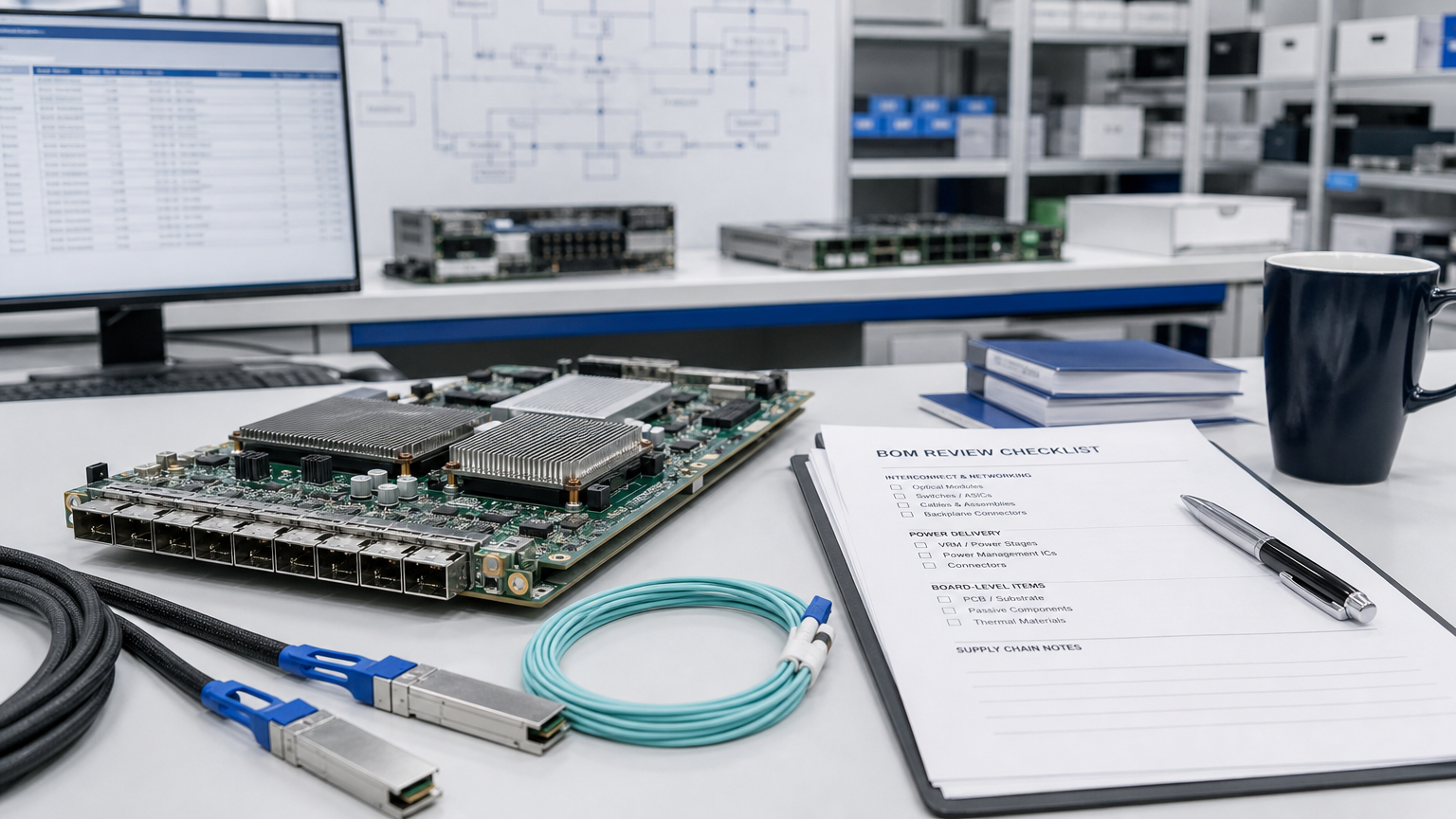
AI data-center coverage often starts with accelerators. For component buyers, the more useful question is narrower: which signal-path and power-delivery items around the accelerator fabric deserve earlier review? Recent public coverage points to a clear architecture signal. Electronic Design described optical circuit switching as a response to AI workloads that strain electrical networks, while TrendForce has separately framed scale-out networking and scale-up platforms as contested areas involving Ethernet, InfiniBand, switches, software, and interconnect ecosystems.
That does not prove a broad shortage in connectors, switch ICs, optical modules, cables, or power-management devices. It does mean these lines should not be left as late-stage accessories in a data-center or high-performance-computing BOM. When network topology, rack density, and accelerator counts change, the surrounding board-level parts can become qualification, documentation, and sourcing constraints before the headline device is the only problem.
What changed for the interconnect family
The practical signal is that AI clusters are forcing more attention onto the fabric between compute nodes. Electronic Design’s article on optical circuit switching says AI workloads are straining electrical networks and presents programmable optical circuit switching as one way to reduce latency, power consumption, and network complexity. The important sourcing takeaway is not that every buyer must move to a new optical architecture. It is that network architecture is becoming a first-order design and procurement variable, not a back-office connectivity detail.
TrendForce’s InfiniBand-versus-Ethernet analysis makes the same issue visible from another direction. It describes scale-out AI data centers as involving tens of thousands of interconnected nodes and contrasts InfiniBand with Ethernet-based approaches, including the Ultra Ethernet Consortium specification work. TrendForce’s separate scale-up analysis says the AI platform battle has moved beyond chip performance into interconnects, switches, software, and ecosystem choices. Those claims support a narrow BOM-review angle: high-speed signal path parts, switch silicon, cables, transceivers, connectors, timing, retimers, power delivery, and thermal-adjacent items should be mapped early when AI networking requirements change.
What this means for PCX buyers
For PCX buyers, the first action is exposure mapping, not panic buying. A procurement team supporting data-center equipment, test platforms, accelerator-adjacent boards, networking appliances, or industrial systems touched by AI demand should ask which MPNs sit in the network path and which ones are single-sourced, long-qualified, or dependent on a narrow approved vendor list.
The review should include connectors, cable assemblies, cages, high-speed board-to-board interfaces, backplane items, Ethernet or InfiniBand-adjacent ICs, retimers, clocking components, logic, sensors used in thermal or power monitoring, and power management ICs. These are not interchangeable commodities once signal integrity, qualification, agency requirements, mechanical fit, and firmware dependencies are in play.
The buyer question is therefore specific: if an AI-networking design changes port speed, topology, optical reach, rack density, or power envelope, which approved parts become harder to replace on short notice? PCX can help customers frame that question at the MPN level through disciplined sourcing review, available alternates, documentation checks, and RFQ timing without implying that any particular line is universally constrained.
What to check in the BOM
A useful interconnect BOM review starts with the signal path. Identify the connector families, cages, cable and wire items, backplane parts, retimers, switch ICs, PHYs, clocking devices, EEPROMs, management controllers, discretes, and passives that support the network fabric. Mark which items have strict layout, insertion-loss, impedance, or thermal requirements. Those parts deserve a different sourcing posture than low-risk catalog substitutions.
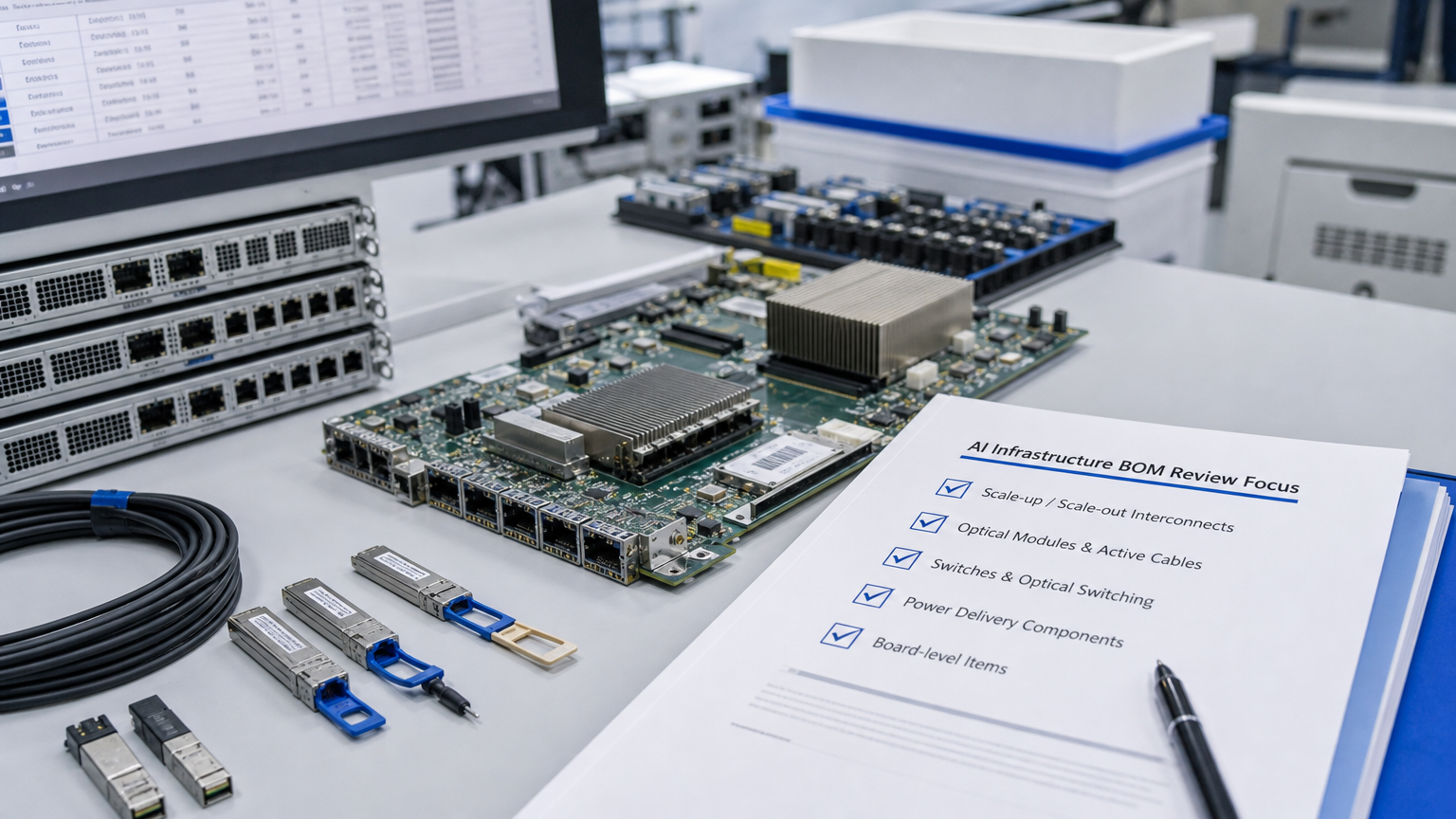
| BOM area | Buyer review question | Why it matters |
|---|---|---|
| High-speed connectors and cables | Are qualified alternates documented for the exact speed, footprint, and mechanical envelope? | Mechanical and signal-integrity limits can make a nominal alternate unusable. |
| Switch ICs, PHYs, retimers, and logic | Which devices are tied to firmware, board layout, or vendor software? | Electrical and software dependencies can turn a part change into a redesign. |
| Optical-adjacent parts | Which transceiver, sensor, clocking, and power components support the optical path? | Optical architecture choices still create board-level sourcing exposure. |
| Power delivery | Do regulators, MOSFETs, discretes, capacitors, and protection devices have approved alternates? | Higher network density can expose power and thermal margins. |
For buyers who need availability checks or alternate sourcing support, the clean next step is to send the exact MPN list, target quantities, acceptable date codes, documentation needs, and any approved alternates through the PCX parts request form. The more precise the BOM context, the easier it is to separate feasible sourcing options from risky substitutes.
What alternates and forecasts can solve
Alternates can help only when they are treated as engineering and documentation decisions, not just purchasing substitutions. A second-source connector still needs the right pinout, plating, mating cycle, package height, and signal-performance fit. A replacement power regulator may need compensation review, thermal validation, and lifecycle checks. A switch IC or retimer can carry firmware, layout, and vendor-support implications that do not show up in a simple part description.
Forecast review is still useful, but it should be targeted. Instead of extending every line item because AI demand is in the news, buyers should prioritize parts that are long-qualified, single-sourced, or tied to high-speed signal integrity and power-delivery margins. If demand is uncertain, scheduled releases, partial coverage, or a monitored RFQ process may be more responsible than speculative buying.
What quality checks still matter
Urgent interconnect sourcing can raise quality risk because many of these parts are visually similar while being electrically or mechanically different. Connectors may share a family name but differ in plating, keying, latch geometry, impedance, or temperature rating. Cables can vary by shielding, bend radius, certification, and assembly quality. ICs may have package, revision, firmware, or lifecycle differences that matter for field reliability.
That is why procurement should keep documentation, traceability, inspection, and approved-source discipline in the workflow. The goal is not simply to find a part quickly. It is to find a part that fits the design intent and purchasing requirements. When a buyer is forced into the open market, quality review and counterfeit-avoidance discipline become part of the sourcing decision, not paperwork after the PO.
What not to assume from the AI networking signal
There are limits to what the public sources support. They support the view that AI data-center networking is becoming more architecturally important and that Ethernet, InfiniBand, optical switching, switches, and interconnect ecosystems are active areas of competition. They do not, by themselves, support a claim that every connector, switch IC, cable, transceiver, or power-management IC is in shortage. They also do not justify exact lead-time, price, allocation, or availability claims without separate public evidence.
The disciplined conclusion is narrower and more useful: interconnect-heavy BOM lines deserve earlier review because architecture pressure can reveal qualification and sourcing fragility. For procurement leaders, that means checking exact MPN exposure, alternates, lifecycle status, documentation, and demand timing before an urgent build makes every option feel acceptable.