
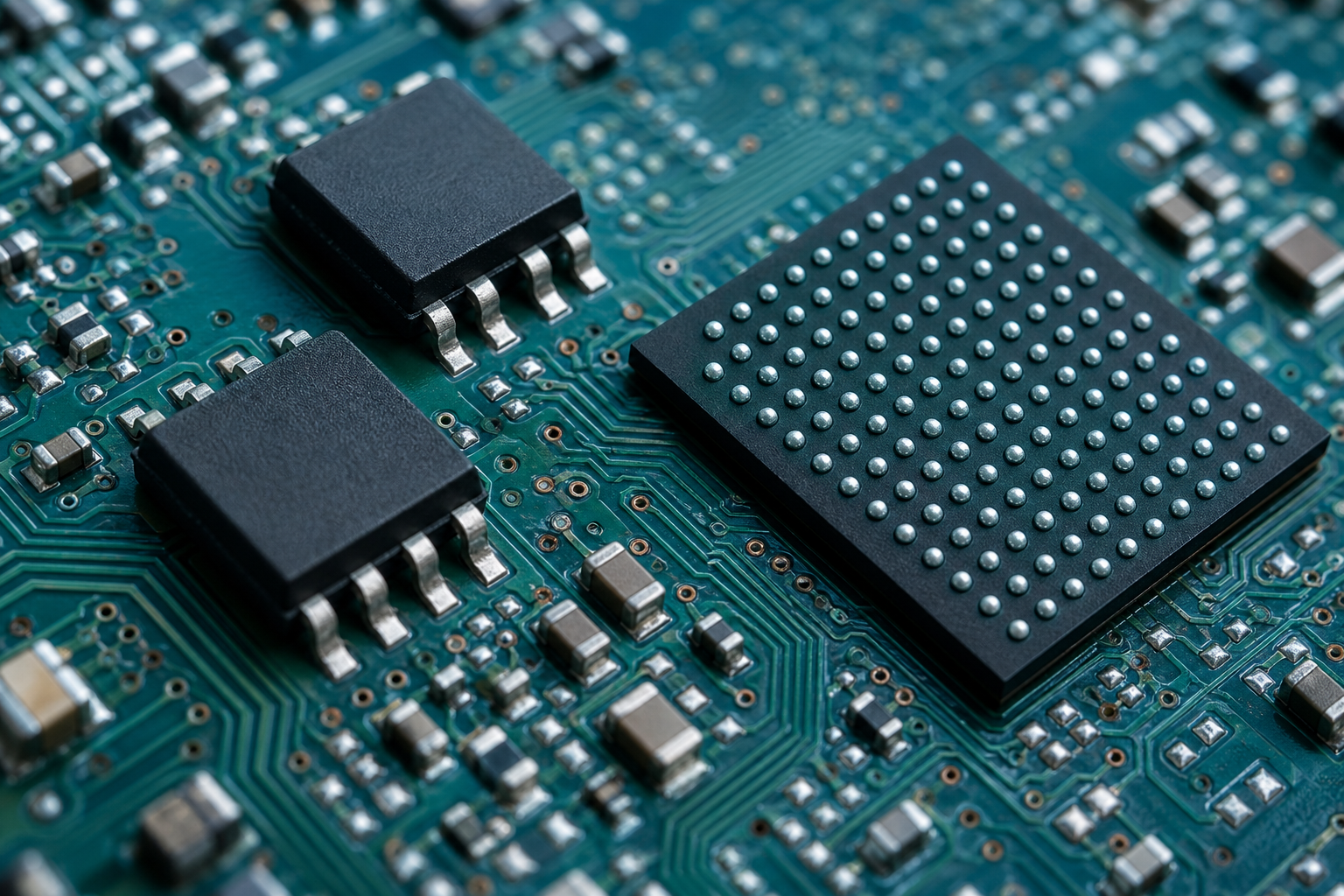
Flash got the headline this cycle. After years of DRAM leading every memory shortage story, NAND flash contract prices jumped an estimated 70–75% quarter-over-quarter in Q2 2026 — the steepest move in roughly fifteen years, and for the first time in this cycle, faster than DRAM. NOR flash and SLC NAND, the workhorses of embedded boot and storage, are caught in the same updraft.
What makes this one harder to manage than a normal price spike is the mechanism. Analysts are describing it less as a cyclical shortage and more as allocation exhaustion: after suppliers scaled back NAND output in late 2025, several have paused 2026 quotations entirely rather than commit to a price they expect to rise. For a buyer, a quote you can’t get is worse than a high one — and that’s the situation a lot of flash lines are now in.
What changed
The numbers are stark. Industry trackers put Q2 2026 NAND contract increases at 70–75% QoQ, on top of roughly 95% jumps the prior quarter, and November contract pricing had already climbed more than 60% as hyperscalers bought capacity for AI data centers. The supply-demand gap is at its widest since 2011 across DRAM, NAND, and HBM alike.
It reaches well beyond raw NAND. GigaDevice — one of the few suppliers spanning NOR flash, SLC NAND, and specialty DRAM — has reported tight supply and rising prices across all three feeding its growth, with niche DRAM and NAND prices expected to climb through 2026. When a primary second-source supplier for embedded flash is itself capacity-constrained, the parts that depend on it tighten in sympathy.
What this means for PCX buyers
Flash is uniquely painful to second-source because it’s so often firmware- and footprint-coupled. A serial NOR device holding boot code, or a managed NAND part tied to a specific controller, isn’t a casual swap — change it and you may be revalidating boot, wear-leveling, or qualification. So when a part like the GigaDevice GD25Q80CSIG serial NOR tightens, the cost of “just substitute” is rarely just the unit price difference.
The exposure is also brand-concentrated in ways worth mapping. Second-source NOR and SLC NAND from vendors like GigaDevice and ISSI, and end-of-life NAND from the majors, are exactly the categories where authorized availability thins first. An SK Hynix NAND device such as the H27QDG882BDA-BCF that’s already hard to find through distribution becomes harder still in an allocation environment.
What is not confirmed yet
A market-wide price surge and paused quotations are real, but they don’t translate into a uniform, named-MPN allocation for every flash device. Some parts remain quotable at elevated prices; others are genuinely on hold while suppliers wait for capacity clarity. Treating the whole category as “unobtainable” can trigger panic buying at the worst possible pricing.
The disciplined read is to confirm status line by line — quotable, allocated, or end-of-life — before committing. Where suppliers have paused quotes, the secondary market may be the only responsive channel; where a part is merely expensive, a measured forward buy may beat a spot scramble. The difference is only visible at the MPN level.
Component families to check
- Serial NOR flash (boot) — GigaDevice GD25, ISSI IS25, and Cypress/Infineon S25 families holding boot/config code.
- SLC NAND — industrial-grade storage where endurance and long life matter; tightening as capacity shifts to high-density TLC for AI storage.
- Managed / raw NAND from the majors — SK Hynix, Kioxia, Micron devices already on thin distribution.
- Density-specific parts — smaller, legacy densities that fabs deprioritize first as they chase AI-scale capacity.
For each, capture current status, open-order coverage, and whether a footprint-and-protocol-compatible alternate is already qualified.
Quality and traceability discipline
Flash is a counterfeiter’s favorite because the fraud is easy to hide and hard to spot: blank or recycled die with forged markings, re-marked densities and speed grades, and reclaimed parts pulled from e-waste. A faked flash device can program correctly on the bench and then fail in the field as endurance or retention collapses — the worst kind of defect because it ships.
That’s why functional and endurance-aware testing matters more for flash than for almost any other category. Beyond traceability and date-code/lot photos, insist on electrical and programming verification, and on X-ray or decap sampling against a known-good reference. In an allocation market flooded with desperate demand, the suspiciously available, suspiciously cheap lot is the one to walk away from.
Buyer checklist for the flash squeeze
- Map flash exposure across NOR (boot), SLC NAND, and managed/raw NAND lines.
- Confirm quote status per MPN — quotable, allocated, or paused — before you plan around it.
- Protect boot-critical lines first. A stalled boot ROM stops the whole build; prioritize those.
- Pre-qualify protocol-compatible alternates where firmware allows, so you’re not revalidating under fire.
- Test hard. Add programming/endurance verification on any secondary-market flash.
Where PCX can help
Pacific Component Xchange sources the NOR and NAND flash that’s hard to find when authorized channels go to allocation — second-source GigaDevice and ISSI parts, end-of-life NAND from the majors, and the legacy densities fabs deprioritize. We help buyers confirm what’s actually obtainable, protect boot-critical lines, and screen incoming flash so an allocation buy doesn’t become a field-failure problem. Pricing reflects a live, fast-moving market, not a stale list.
A few flash devices we’re actively sourcing:
- GD25Q80CSIG — GigaDevice serial NOR flash
- IS25LP032D-JNLE-TY — ISSI serial NOR flash
- S25HL01GTDPMHI010 — Cypress/Infineon serial NOR flash
- H27QDG882BDA-BCF — SK Hynix NAND flash
- GD9FU4G8F3ALGI — GigaDevice SLC NAND flash
- H27QEG8M3MW2-BCF — SK Hynix 3D TLC NAND flash
If a NOR or NAND line has gone quiet on quotes, send us the part number and quantity and we’ll tell you what’s obtainable, what it costs against today’s market, and how fast.
Sources and further reading
- Tom’s Hardware — NAND wafer shortages push November contract prices up over 60%
- Tom’s Hardware — DRAM and NAND contract prices to climb again in Q2
- Digitimes — GigaDevice sees niche DRAM and NAND prices rising through 2026
- NAND Research — Memory & NAND flash crisis: May 2026 update
- Elinfor — NAND flash prices are surging in 2026