
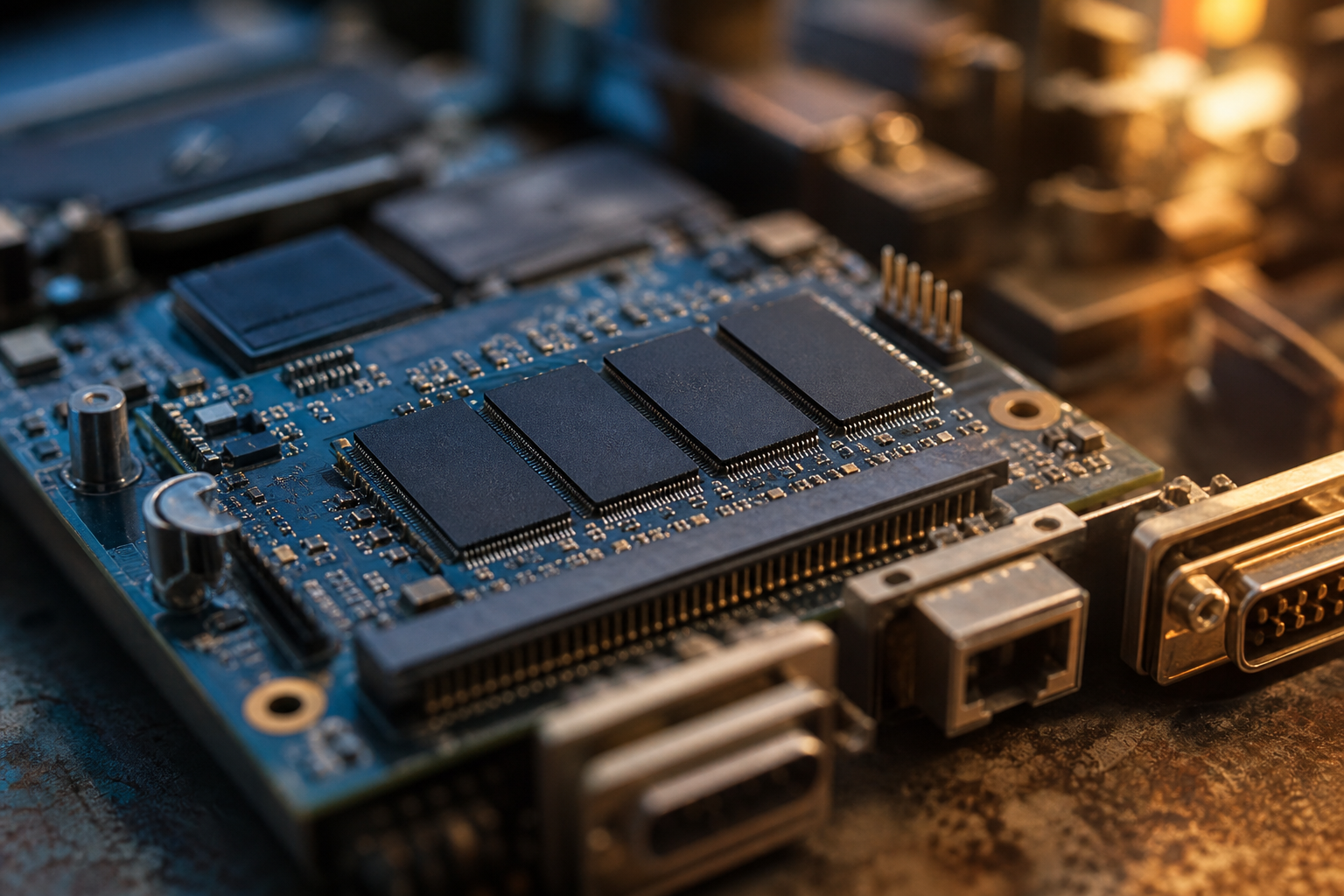
For most of the industry, DDR3 is a closed chapter. SK Hynix stopped supplying it at the end of 2023, Samsung wound down production in 2024, and the major makers have moved their wafers to DDR5 and HBM. But “the industry moved on” and “your board moved on” are two very different statements — and for the routers, switches, industrial controllers, and embedded platforms still built around DDR3 and low-voltage DDR3L, the part is as necessary as it ever was.
That gap between dwindling supply and steady embedded demand is the whole problem. DDR3 is now a genuinely end-of-life category that a large installed base still consumes, and that combination turns routine memory procurement into a last-time-buy decision with a real deadline. The buyers who treat it that way keep their lines running; the ones who assume “we’ll just reorder” get caught.
What changed
The structural exit is now on the record. Samsung discontinued DDR3 production in the second quarter of 2024 and SK Hynix stopped supplying it at the end of 2023, leaving Micron and a set of specialist suppliers as the remaining producers. Distributors have followed with formal phase-out notices — Advantech, for example, has published an end-of-life date in late 2025 with a last-time-buy window closing in late 2026 for selected DDR3L modules.
At the same time, the broader 2026 memory squeeze is pulling pricing and capacity toward newer parts, and legacy DDR3/DDR4 contract prices have been rising faster than the headline numbers as remaining capacity is reallocated. DDR3 is under 5% of total memory consumption now, which is precisely why it’s vulnerable: too small to defend a fab line, too embedded to disappear quietly.
What this means for PCX buyers
If a shipping product uses DDR3 or DDR3L, the relevant question is no longer “what does it cost this quarter” — it’s “how many will I ever need again, and from where.” Once the original maker has exited, every unit you’ll consume over the remaining life of the design has to come from remaining production or the secondary market. That makes forecasting, not negotiation, the core skill.
The coupling that makes this painful is the same as always: a DDR3 device like the Samsung K4B2G1646F-BYMA is tied to its controller, SPD, and layout, so redesigning around the shortage usually costs more than securing the part. And voltage matters here specifically — a 1.5V DDR3 part and a 1.35V DDR3L part such as the SK Hynix H5TC4G63EFR-RDI are not interchangeable unless your platform explicitly supports both.
What is not confirmed yet
End-of-life from one maker is not the same as the part being gone. Micron is understood to be producing DDR3 past 2026, and second sources remain: Nanya is a qualified DDR3 supplier, and ISSI has publicly committed to long-term DDR3 availability well into the next decade. So a Samsung or SK Hynix discontinuation notice is a signal to act, not proof that your exact density and organization are unobtainable.
The practical takeaway is to verify availability at the MPN level before deciding between a last-time-buy and a qualified second source. Sometimes the right move is to secure remaining inventory of the exact part; sometimes it’s to qualify a same-spec Nanya or ISSI device that will be produced for years. Either is defensible — guessing is not.
Component families to check
Walk the BOM for these and flag every DDR3-class line:
- Standard 1.5V DDR3 SDRAM — the densities Samsung and SK Hynix have already exited; treat these as last-time-buy candidates first.
- 1.35V DDR3L — common in low-power embedded designs; confirm voltage class before any substitution.
- Discrete x8 / x16 devices on industrial boards — networking and control gear where a single die holds up the build.
- Second-source-eligible parts — where a Nanya or ISSI equivalent exists, qualifying it now may beat stockpiling an exited part.
For each line, the output you want is: original maker status, remaining-life quantity, and whether a long-term second source is already qualified.
Quality and traceability discipline
End-of-life parts are a magnet for counterfeits, because demand persists exactly when legitimate supply dries up. With DDR3 that shows up as re-marked date codes, re-balled BGAs pulled from scrapped boards, and lower-grade die sold as the right speed bin. On legacy industrial hardware that’s expected to run for a decade, a marginal part isn’t just a yield problem — it’s a field-reliability problem.
So treat any secondary-market DDR3 buy with full diligence: documented traceability, date-code and lot photos before commitment, and inspection that goes past a visual check to X-ray and electrical test at rated speed and temperature. The deeper into a part’s end-of-life you are, the more that discipline matters.
Buyer checklist for legacy DDR3/DDR3L
- Inventory the exposure. List every DDR3 and DDR3L MPN across active and serviced designs.
- Forecast remaining-life demand. Include production, spares, and RMA volume over the full support horizon.
- Decide last-time-buy vs. second source per line. Secure exited parts; qualify long-term sources (Nanya/ISSI) where they exist.
- Lock storage. Hold BGAs under controlled humidity with proper dry-pack handling for multi-year storage.
- Raise incoming inspection on any DDR3 sourced outside the franchised channel.
Where PCX can help
Pacific Component Xchange works the legacy memory market that distribution has stepped away from. We help buyers size honest last-time-buys against what’s actually still circulating, locate exited Samsung and SK Hynix DDR3 densities, and screen incoming material so a legacy buy doesn’t introduce a reliability risk a decade into a product’s life. Pricing is quoted against live availability, since legacy parts move on real-time supply, not a list.
A few DDR3/DDR3L devices we’re actively sourcing:
- K4B2G1646F-BYMA — Samsung 2Gb DDR3 SDRAM
- H5TQ4G83EFR-RDA — SK Hynix 4Gb DDR3 SDRAM
- K4B4G1646E-BYMA0CV — Samsung 4Gb DDR3L SDRAM
- H5TC4G63EFR-RDI — SK Hynix 4Gb DDR3L SDRAM
- NT5CC512M8EQ-EK — Nanya 4Gb DDR3L SDRAM
- NT5CC64M16GP-DI — Nanya 1Gb DDR3L SDRAM
Facing a DDR3 line that’s gone end-of-life at the maker? Send us the part number and remaining-life quantity and we’ll tell you what’s available, whether a qualified second source fits, and what it costs against today’s market.
Sources and further reading
- Advantech — Selected DDR3 DRAM module part numbers and DDR3 EOL notice
- Tom’s Hardware — DDR3 supplies rapidly shrinking
- GLYN — DDR3 and DDR3L: why long-term availability is crucial
- One Profit Tech — Storage giants plan to discontinue DDR3, DDR4 production