
Older Semiconductor Date Codes Need an Acceptance Policy
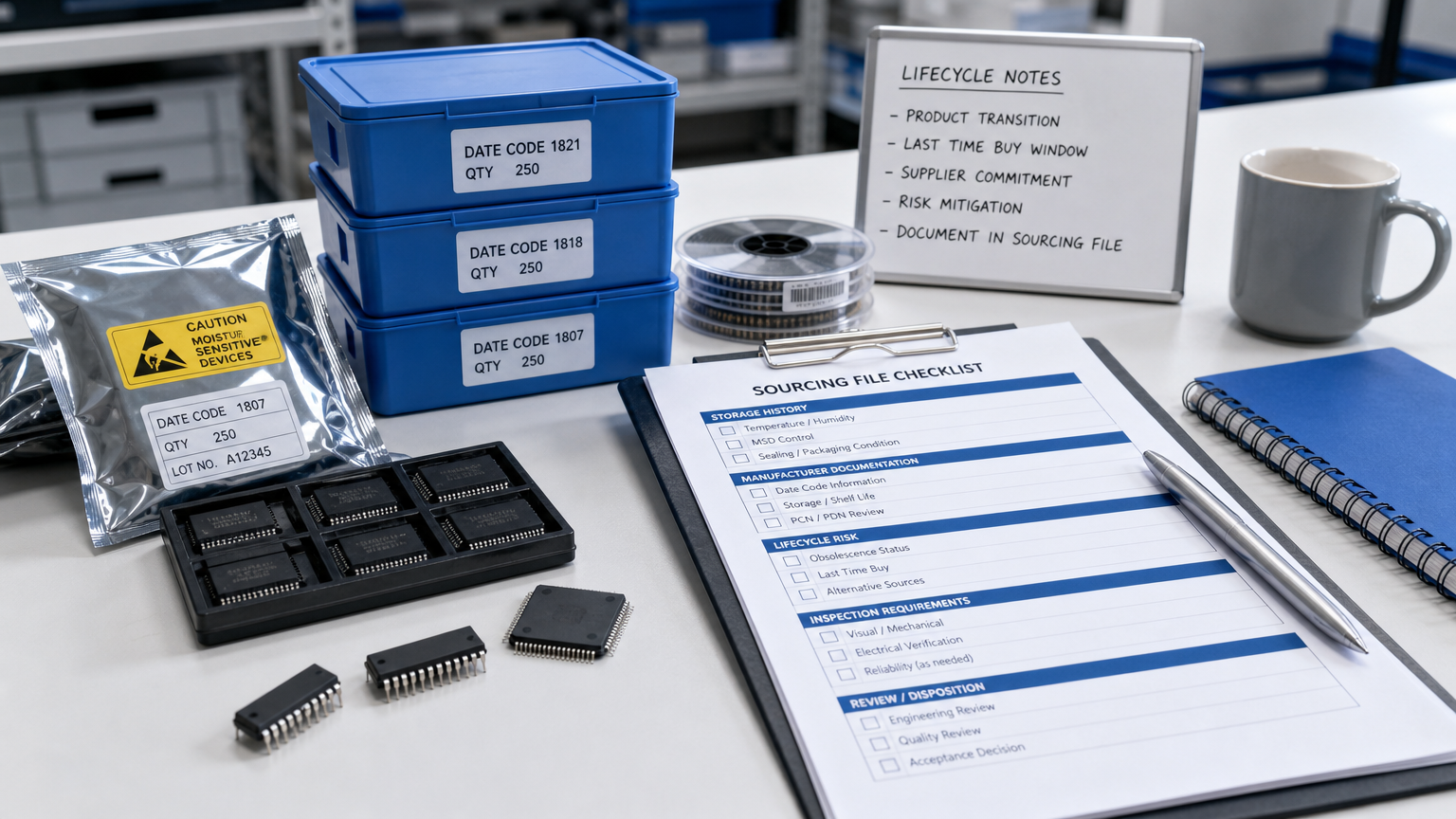
Semiconductor date codes are easy to turn into a yes-or-no rule. For many buyers, that simplicity is part of the appeal: newer markings feel safer, older markings feel harder to defend, and urgent shortages make every exception uncomfortable.
The more useful approach is an acceptance policy. Evertiq reported on May 20 that Ronny Nietzsche of Rochester Electronics is set to discuss whether the electronics industry is overthinking semiconductor date codes at Evertiq Expo Lund. The article frames the issue around assumptions about shelf life, quality, and whether date markings alone should determine usability.
For buyers, the point is not to accept older semiconductors casually. It is to decide in advance what evidence an older lot must provide before purchasing, quality, and engineering can approve it for a particular BOM line.
The decision buyers are really making
A date code is a screening signal. It can flag a lot for closer review, especially when the part sits in a high-reliability, customer-controlled, security-sensitive, or long-life application. But it is not the same as a condition report.
Evertiq’s article says the Lund presentation will challenge long-standing assumptions about component usability and shelf life. It also says that date codes alone are no longer a reliable indicator of component quality and that properly stored semiconductors can remain reliable and field-ready beyond assumptions traditionally associated with older markings.
That creates a practical policy question: which older-date-code parts are never acceptable, which are acceptable only with evidence, and which can proceed through normal purchasing review? The answer may differ for ICs, memory devices, microcontrollers, analog components, MOSFETs, diodes, power-management parts, and other board-level semiconductors.
What this means for PCX buyers
For PCX buyers, an older date code should trigger a controlled review, not a reflex. A reflexive rejection can remove usable supply from consideration. A reflexive acceptance can push quality risk into production, service, or the field.
The safer middle ground is to define acceptance criteria before the RFQ is active. That lets a buyer tell suppliers what evidence matters: lot identity, storage history where available, packaging condition, traceability, inspection scope, and any customer-specific restriction. PCX’s Star Quality Program is relevant because the buyer challenge is evidence discipline, not just locating inventory.
This is especially important for long-life industrial, aerospace-adjacent, medical-adjacent, telecom, and service programs where redesign may be slow and original channels may not have fresh material. It also matters when a semiconductor line is surrounded by other constrained components such as connectors, relays, switches, passives, thermal parts, or electromechanical items that can complicate a full-board recovery plan.

A practical acceptance policy
| Policy question | Why it matters | Buyer action |
|---|---|---|
| Is the date-code limit contractual or internal? | Customer language may leave less discretion than an internal preference. | Separate hard restrictions from reviewable preferences. |
| What is the application risk? | High-reliability or security-sensitive assemblies deserve tighter review. | Classify the BOM line before evaluating supply. |
| What evidence is available? | Lot, packaging, traceability, and inspection information determine confidence. | Ask for evidence in the RFQ, not after award. |
| Who approves exceptions? | Procurement should not own technical acceptance alone. | Route exceptions to quality or engineering when required. |
This policy keeps the discussion specific. It prevents a generic date-code preference from becoming a silent block on all available supply, and it prevents urgency from becoming a silent waiver of controls.
Evidence to request before accepting an older lot
An acceptance policy should name the evidence a supplier must provide. Useful inputs can include the full MPN, manufacturer, date code, lot code, packaging photos when appropriate, moisture-barrier or reel condition, chain-of-custody details, available storage notes, and any prior inspection or testing records.
For integrated circuits and memory, buyers may also need to check revision, firmware, qualification history, and whether alternates have already been approved. For power semiconductors, analog devices, discretes, and mixed-signal parts, environmental and application stress can change the risk discussion. None of those questions is answered by the date code alone.
When the application is low risk and the evidence is strong, an older marking may be a reviewable sourcing option. When the application is high risk or the evidence is thin, the same marking may be a reason to hold, test, escalate, or continue searching.
Where shortage pressure changes the review
Shortage pressure does not make older inventory unsafe by default. It does make process discipline more important because rushed sourcing decisions create openings for weak documentation and suspect supply paths.
Electronics Sourcing reported in April that shortage conditions make stronger sourcing, inspection, testing, supplier qualification, and anti-counterfeit discipline important for protecting OEM schedules, margins, and reputations. That is the right frame for date-code exceptions: urgency should make acceptance criteria clearer, not looser.
If a buyer is evaluating older-date-code supply because normal channels are constrained, the team should also review whether alternates are qualified, whether a scheduled-order plan can reduce repeat urgency, and whether any open-market option needs added inspection steps.
How to put the policy into an RFQ
The RFQ should tell suppliers what the buyer can accept. Instead of asking only for availability and price, include date-code tolerance, required documentation, inspection expectations, and escalation triggers. That helps suppliers avoid presenting material that cannot pass review and helps buyers compare options on more than unit cost.
A good RFQ note might say that older date codes are conditionally reviewable only with lot identity, packaging details, traceability, and inspection support. A stricter application might say that older date codes require written quality approval before purchase. A critical application might disallow them entirely. The important point is to decide deliberately.
If your team is reviewing semiconductor date-code limits on a BOM, share the MPNs, application constraints, target date-code policy, and documentation requirements through the PCX parts request form. PCX can help structure the sourcing conversation around availability, acceptance evidence, and verification needs without treating a single date marking as the whole decision.