
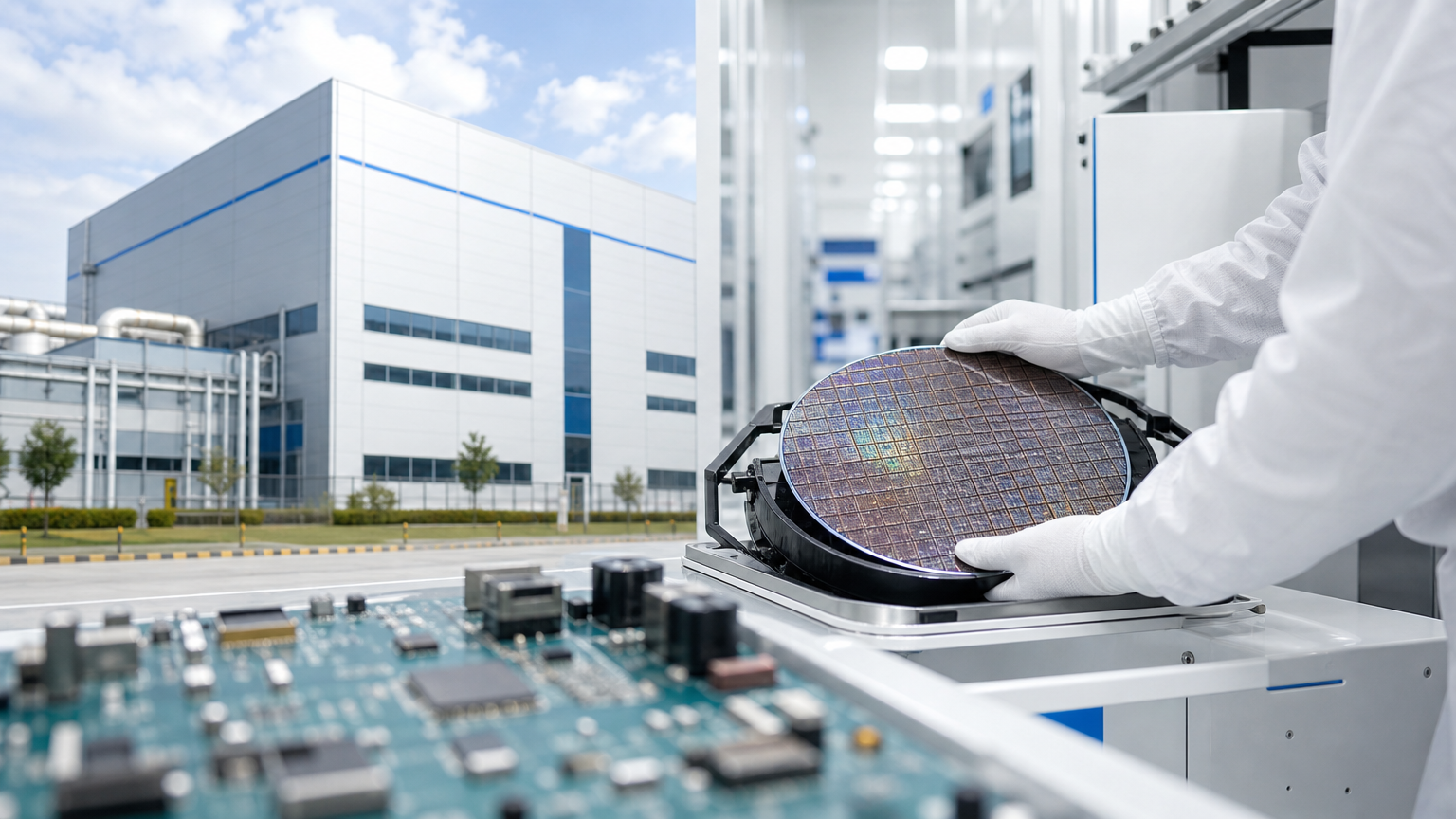
India’s newly approved semiconductor projects matter as a regional diversification signal, especially for buyers watching power, discrete, and packaging capacity. They do not, however, change near-term availability assumptions by themselves.
India’s cabinet has approved two more semiconductor manufacturing projects under the India Semiconductor Mission, both in Gujarat. According to the Prime Minister of India release, one project will combine compound-semiconductor fabrication with assembly, testing, marking, and packaging for mini and micro-LED applications, while the other will build an OSAT facility for discrete semiconductors aimed at power electronics, analog IC, and industrial-system demand.
Evertiq’s May 7 coverage is useful because it translates the announcement into the categories buyers actually track: GaN-related production, semiconductor packaging, and discrete-device output that can matter to automotive, industrial automation, and power-oriented programs. The practical signal for buyers is not instant relief. It is that another region is trying to build more real semiconductor manufacturing depth in categories that sit closer to board-level demand than many advanced-node headlines do.
What India actually approved
The official release says the two approved proposals represent about Rs. 3,936 crore in cumulative investment and are expected to generate 2,230 skilled jobs. Crystal Matrix Limited will establish an integrated facility in Dholera for compound-semiconductor fabrication and ATMP, with mini and micro-LED display manufacturing plus GaN foundry services including epitaxy on 6-inch wafers. Suchi Semicon will build an OSAT facility in Surat for discrete semiconductors, with target applications in power electronics, analog ICs, and industrial systems.
That specificity matters. This is not a vague policy statement about future chip ambition. It names the facility types, target products, and intended end markets. For procurement teams, that makes the story more useful than a generic industrial-policy headline because it points toward packaging, power-device, and industrial-electronics relevance rather than only advanced logic prestige.
Why this matters more than a generic fab headline
Many semiconductor investment stories focus on leading-edge process nodes that matter enormously to hyperscalers and flagship processors but only indirectly to the broader board-level market. This announcement is different. One facility is tied to compound-semiconductor and display-adjacent manufacturing, while the other is explicitly tied to outsourced assembly and test for discrete devices. That puts the buyer conversation closer to real production categories that feed industrial, automotive, and power applications.
For sourcing teams that buy discrete semiconductors or adjacent power-oriented parts, the issue to watch is not whether these projects solve today’s constraints. It is whether they gradually add regional options, packaging depth, and ecosystem resilience in product families that often remain exposed to qualification cycles and second-source limits.
| Project | What was announced | Practical sourcing reading |
|---|---|---|
| Crystal Matrix | Compound-semiconductor fabrication plus ATMP for mini/micro-LED and GaN services | Relevant as a medium-term specialty-capacity and packaging signal, not a short-term relief event |
| Suchi Semicon | OSAT for discrete semiconductors serving power, analog, and industrial applications | Worth watching for execution milestones if your BOM depends on power and industrial device families |
What it does not solve yet
Buyers should be careful not to overread the announcement. The PM India release says momentum is building in the country’s semiconductor ecosystem and notes that some previously approved projects have started or are nearing commercial shipments. Even so, a newly approved project is still several steps away from being a dependable answer to a current production shortage, line-down risk, or alternate-source qualification problem.
Availability only becomes operationally meaningful after construction, equipment installation, process stability, customer qualification, and commercial output all move forward. In other words, the market value of this news is strategic first and transactional later. If a team is under current allocation pressure, it still needs present-tense sourcing work: approved manufacturers, inspection discipline, timing review, and verified supply options.
What buyers should watch next
The next meaningful signals are execution milestones rather than larger rhetoric. Watch for construction progress, equipment and process updates, sample or pilot output, customer qualification news, and any public indication that these facilities are moving from approval to reliable commercial production. Those milestones matter more than headline investment totals because they tell buyers when a project starts becoming relevant to planning assumptions.
It is also worth watching how these projects fit into India’s broader semiconductor buildout. The official release says the total number of approved projects under the mission has now reached 12. That does not guarantee broad near-term relief, but it does suggest that buyers should keep India on the map as a region to monitor for future packaging, specialty-process, and electronics-manufacturing depth.
How PCX readers can use the signal now
The practical response is simple: keep the announcement in your market map, but do not let it replace present sourcing discipline. If your BOM has exposure to power devices, analog support parts, or industrial-electronics components, use this kind of news to refine long-range regional assumptions and to frame conversations about second sources and qualification timing.
It can also support broader supply chain resilience planning. When credible regional manufacturing announcements appear, procurement and engineering teams get a better sense of where future capacity might emerge, which categories deserve closer watch, and where to ask harder questions about dependency. For active requirements, buyers can still move immediately by sending PCX an RFQ for current sourcing support while longer-horizon market signals continue to develop.