

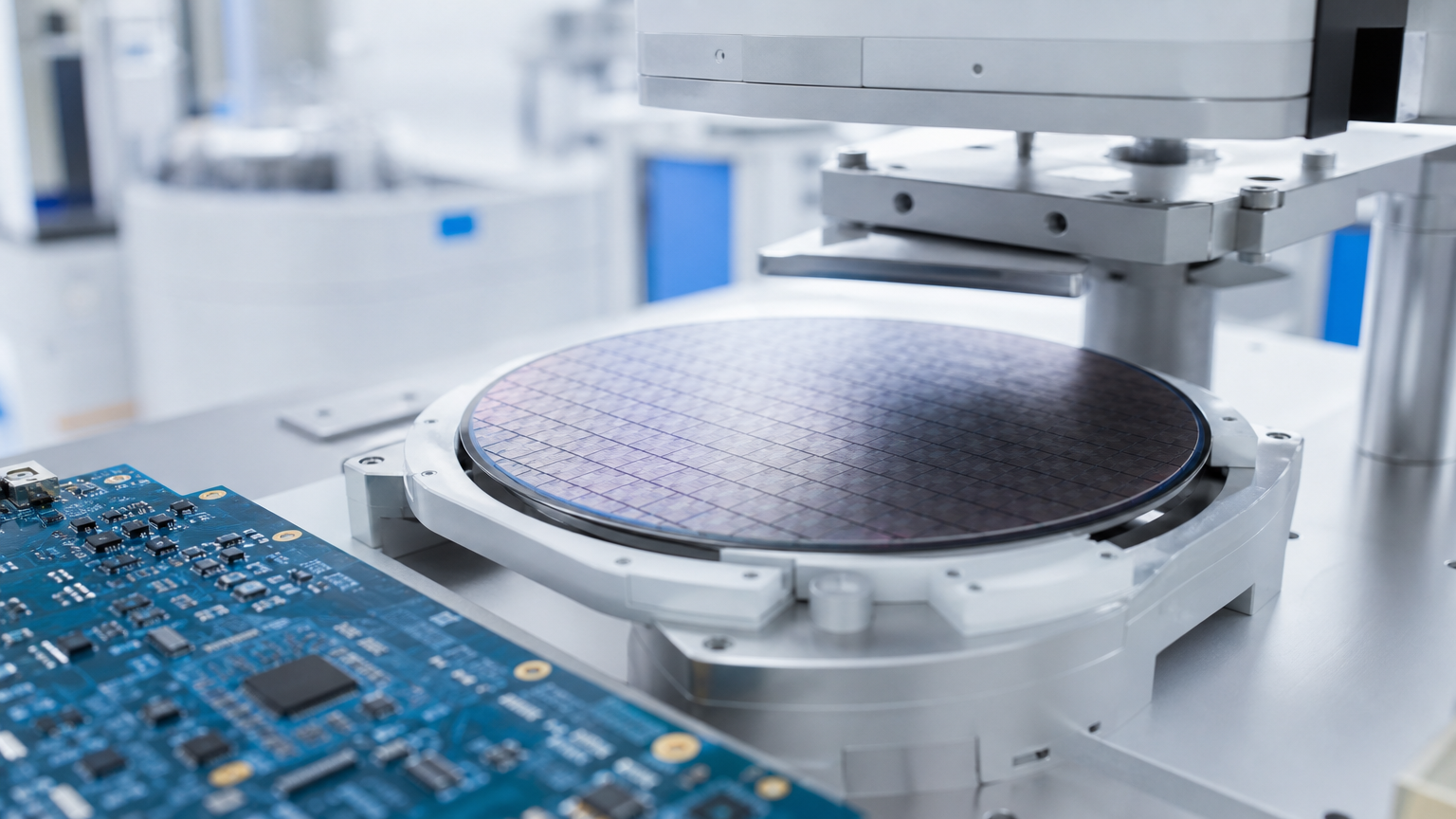
Silicon wafer shipments turned higher in the first quarter of 2026, but buyers should read that as an upstream demand signal rather than proof that today’s board-level constraints are broadly resolved.
Fab and wafer headlines matter because they help procurement teams understand where utilization is firming, where suppliers may prioritize capacity, and which component families deserve a closer watch. They do not automatically answer the question buyers usually care about most: whether the exact part numbers on a live BOM are about to get easier to source.
That distinction matters in this week’s wafer data. SEMI reported a year-over-year increase in worldwide silicon wafer shipments for the first quarter, and Evertiq’s follow-up coverage underscored that demand tied to AI data centers, advanced logic, memory, and even power-management devices remains an important part of the story. The practical signal for buyers is not broad relief. It is that upstream demand is still strong enough to keep discipline around availability, timing, and alternates firmly in place.
What the shipment report says
SEMI said worldwide silicon wafer shipments rose 13.1% year over year in Q1 2026 to 3,275 million square inches, up from 2,896 MSI in the same quarter a year earlier. At the same time, shipments were down 4.7% sequentially from 3,437 MSI in Q4 2025, which SEMI described as typical seasonality. That combination matters: demand looks healthier than it did a year ago, but the data is not a straight-line story of immediate acceleration every quarter.
Evertiq’s summary of the release adds useful context for sourcing teams. It highlighted SEMI’s point that AI-data-center demand is still supporting advanced logic and memory demand, while also extending into power-management devices. Evertiq also noted the recovery is not uniform across end markets. That unevenness is important because buyers rarely experience the semiconductor market as one neat category. Exposure usually shows up in specific IC families, approved vendor lists, package types, or qualification bottlenecks.
What it may change later
Stronger wafer demand can still matter for near-future planning. When upstream wafer activity improves, it can influence how suppliers think about utilization, capital intensity, and where capacity gets directed first. If AI-linked demand remains firm in advanced logic, memory, and adjacent power-management categories, buyers should expect those pull patterns to keep shaping priorities across the supply base.
That does not mean every board-level component becomes harder to buy. It does mean some categories may stay strategically important for suppliers even while other areas recover more quietly. For procurement teams, the useful move is to refresh which semiconductor lines on the BOM have the most exposure to AI infrastructure demand, high-performance compute programs, or power-delivery content that could feel second-order pressure.
The issue to watch is less whether wafer demand improved and more whether that improvement changes the availability profile of the exact devices your build schedule depends on.
What it probably does not change now
Quarterly wafer data should not be mistaken for a finished-goods availability report. Wafer starts and shipment area are upstream signals. Buyers still have to account for packaging and test capacity, customer allocation choices, qualification timing, die/package combinations, distributor inventory posture, and the simple fact that many constrained programs depend on a narrow set of approved manufacturers.
That is why a healthier wafer picture can coexist with stubborn spot shortages or awkward quote conditions in selected categories. A procurement leader reviewing this signal today should not relax MPN-level monitoring, alternate-part work, or supplier follow-up just because the top-line wafer number improved. The sourcing risk is less about the headline and more about assuming a market-level statistic solves a part-level problem.
| This signal helps with | This signal does not prove |
|---|---|
| Orienting the team around upstream semiconductor demand | That current quoted lead times will improve across the full BOM |
| Identifying where AI-related pull may still be shaping supplier priorities | That packaging, test, and qualification bottlenecks are resolved |
| Refreshing watchlists for exposed IC categories | That every approved part number now has comfortable supply |
Which current BOMs may still need attention
Buyers with exposure to memory, advanced logic, and power-related semiconductor content should keep reviewing exact line items instead of general market categories. That can include server-adjacent memory devices, compute-oriented integrated circuits, and power-management components that support dense processing or data-center infrastructure. It can also include industrial and embedded programs that use older or already-qualified devices and cannot switch suppliers quickly.
- Reconfirm which integrated circuits on current builds have the least alternate flexibility.
- Review power-delivery exposure, especially where power-management ICs are tied to dense compute or industrial control designs.
- Separate long-horizon market context from the parts that actually threaten schedule risk in the next 30 to 90 days.
- Refresh escalation paths for engineering, quality, and purchasing before the next constrained quote forces a rushed decision.
If the team needs a broader planning frame, PCX’s earlier note on supply-chain resilience is still a useful reminder that resilience is built through watchlists, alternates, and controlled response windows rather than headline chasing.
Buyer takeaway
SEMI’s wafer data is worth paying attention to because it suggests the upstream semiconductor environment is healthier than it was a year ago and still heavily influenced by AI-driven demand. But for live sourcing work, the better conclusion is measured: use the signal to update assumptions, not to declare relief.
Availability, verification, and timing all become more important when buyers start translating broad market data into actual procurement decisions. If a current build depends on exposed memory, logic, or power devices, now is a good time to tighten the MPN watchlist, verify alternate paths, and decide where earlier engagement is justified.
Send PCX the parts list for BOM review and sourcing support.