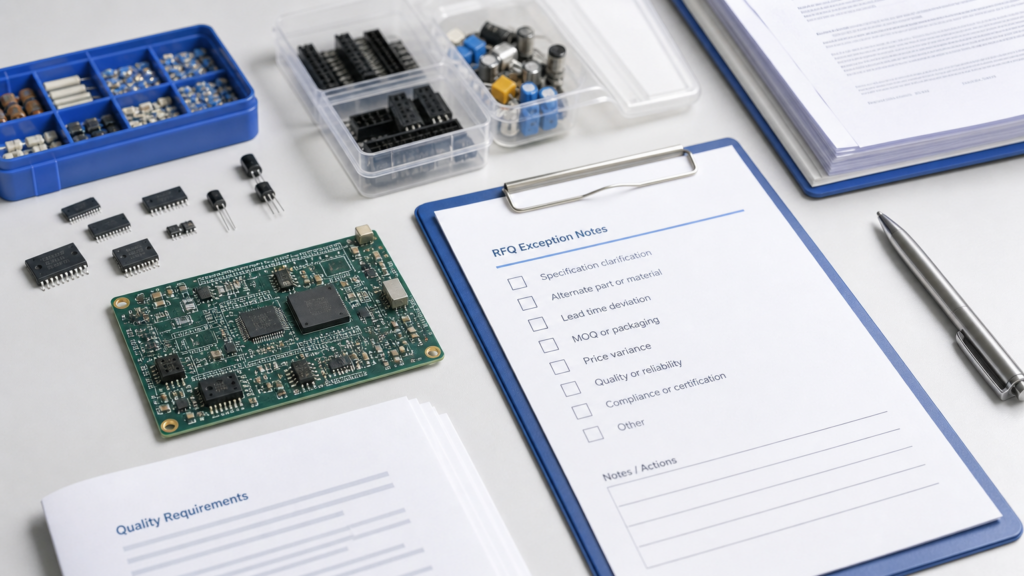
RFQ Exception Notes Help Buyers Separate Market Noise From Sourcing Risk
Broad component-market warnings are useful only if they change the way a buyer handles a specific part. Without that link, a warning becomes background noise. With it, the RFQ can show which MPN deserves extra review and why.
One practical way to keep the review controlled is an RFQ exception note. The note does not declare a shortage. It records the reason a line needs added sourcing attention: a tight build date, no approved alternate, lifecycle uncertainty, open-market exposure, packaging limits, date-code requirements, or a quality review trigger.
What this means for PCX buyers
Evertiq reported on July 20 that artificial intelligence infrastructure, geopolitical tension, raw-material pressure, and longer delivery times are creating a more difficult environment for electronics manufacturers. The article discusses board-level categories including processors, memory, power-management components, networking equipment, cooling systems, and basic components.
For PCX buyers, the important move is not to turn that reporting into a blanket availability claim. The safer move is to ask which BOM lines have a real exception: an exact part with limited supplier options, a schedule that cannot absorb revalidation, or a quality requirement that must be visible before a quote is accepted.
What belongs in the exception note
A useful exception note is short, but specific. It should answer four questions before the RFQ reaches a shortlist:
- What is exposed? Name the manufacturer part number, application, quantity, build date, and whether partial shipment is useful.
- What cannot change? Record electrical limits, package, temperature grade, moisture handling, date-code window, packaging format, and approved manufacturer list.
- What needs proof? State traceability, original documentation, packaging-label review, lifecycle status, PCN or PDN concerns, and inspection expectations.
- Who approves the path? Identify whether engineering, quality, or supply-chain leadership must review an alternate, open-market offer, or last-time-buy decision.
This keeps urgency from collapsing several different questions into one word: available. A part can be available and still be wrong for the build if the supplier path, documentation, lifecycle status, or inspection plan is not acceptable.
Lifecycle exceptions are different from shortage exceptions
Electronics Sourcing reported that component product lifecycles continue to shorten and that end-of-life notifications, longer lead times, and redesign-cycle timing affect supply-chain teams.
That is a different RFQ exception from a spot shortage. A lifecycle exception asks whether the part is still a good production choice for the next build window. The note should capture whether the team has checked lifecycle status, whether a last-time-buy discussion is needed, whether an alternate has already been validated, and whether the next redesign window is realistic.
Counterfeit-risk exceptions should be explicit
A separate Electronics Sourcing article describes counterfeit-risk controls including supplier evaluation, traceability to the original component manufacturer, packaging and documentation review, external visual inspection, and risk-based testing approaches. It also connects shortage and obsolescence conditions with heightened counterfeit-risk mitigation needs.
An RFQ exception note should make those controls visible when the sourcing path moves beyond straightforward authorized availability. It should not promise that inspection removes every risk. It should say what evidence is required before material can move from quote to purchase order.
How to use the note without slowing the buy
The exception note should be attached only to lines that need it. If a common passive, connector, discrete semiconductor, memory device, or power-management IC has routine authorized availability and no build sensitivity, the RFQ can stay simple. If the part is schedule-critical, hard to replace, lifecycle-sensitive, or quality-sensitive, the note prevents the team from rediscovering the same constraints after a supplier response arrives.
That distinction matters commercially. A well-scoped note can help suppliers return cleaner options, help buyers compare offers on more than price and lead time, and help engineering or quality reviewers focus on the decision that actually needs approval.
Where PCX can help
PCX can help turn a broad sourcing concern into an exact-MPN exception review. Buyers can share the part number, quantity, required date, acceptable alternates, date-code limits, packaging requirements, and documentation expectations through the PCX parts request form. For quality-sensitive or hard-to-find material, PCX’s Star Quality Program is the appropriate internal reference point for inspection, documentation, and sourcing-discipline discussions.