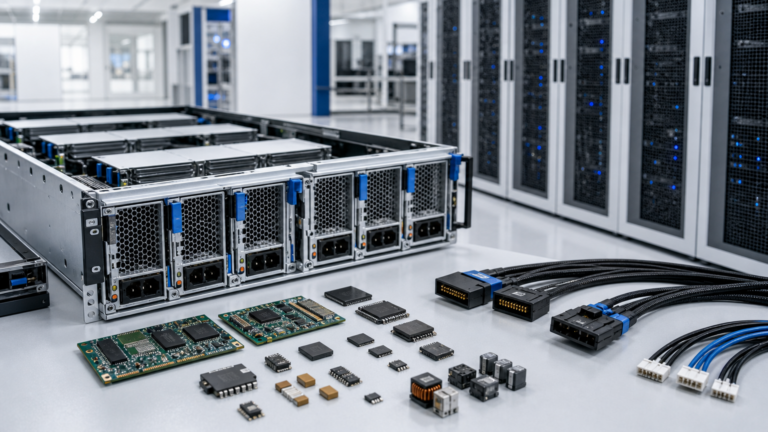
AI infrastructure pressure is usually discussed in terms of GPUs, HBM, packaging, and power. For passive-component buyers working around memory, power management, and integrated circuits schedules, the more immediate operating question is quote timing: which MLCC lines need earlier supplier checks before lead-time movement reaches the production schedule?
Recent public reporting points to multilayer ceramic capacitors as one of the passive component families worth reviewing before the next quote window. Astute Group reported on June 5 that AI infrastructure demand is tightening MLCC supply, with lead times exceeding 20 weeks and constraints expected to persist through 2027. eeNews Europe reported in May that AI server demand is increasing MLCC intensity, while Passive Components Blog reported in late June that AI-grade and automotive MLCC lead times are elevated and volatile for certain codes.
Those claims do not prove that every MLCC, capacitor, or passive line is constrained. They do justify a focused sourcing review for BOMs that use high-capacitance, high-reliability, temperature-sensitive, or power-integrity-critical parts.
What this means for PCX buyers
For PCX buyers, the issue is timing. A passive part that looked routine on the last build can become a schedule risk when the approved manufacturer list is narrow, the design depends on a specific electrical behavior, or the buyer waits until an RFQ is already urgent. Passive components deserve the same evidence discipline as active ICs when lead-time signals start to move.
The MLCC signal buyers should separate from the noise
The useful signal is not simply that AI servers use many capacitors. It is that higher power density, package-level power delivery, and dense accelerator boards can shift demand toward specific MLCC classes, case sizes, voltage ratings, dielectrics, and approved manufacturers.
eeNews Europe reported that the production of MLCCs is dominated by Murata, TDK, Kyocera AVX, Taiyo Yuden, Samsung Electro-Mechanics, and Yageo. Passive Components Blog similarly described concentrated supply among leading MLCC suppliers. When a BOM depends on a narrow approved-manufacturer list, procurement risk can appear even if commodity capacitor availability still looks normal.
That distinction matters. A buyer can usually source a common capacitor more flexibly than a tightly specified MLCC that is bound to a power-integrity target, temperature profile, voltage-derating rule, customer approval, or regulatory file. The exposed part is not the word capacitor; it is the exact MPN and approved substitute set.
Why alternates may need engineering review first
Capacitor alternates are not always like-for-like commercial substitutions. MLCC performance can change with DC bias, temperature, frequency, package size, board placement, and operating-current conditions; Electronic Design has also shown why capacitor evaluation may need circuit-condition analysis rather than nominal values alone. Passive Components Blog specifically highlighted DC-bias, temperature, and reliability requirements in AI hardware designs. eeNews Europe also noted that redesigning a PCB to accommodate different capacitor footprints can be costly and time-consuming for industrial automation and medical electronics.
For sourcing teams, that means an alternate list is only useful if it includes the evidence engineering needs to accept the change. The file should capture dielectric class, capacitance after derating, voltage rating, package size, termination, temperature range, lifecycle status, approved manufacturer, and any test or customer-approval requirement.
This is also where traceability matters. When lead times stretch, the temptation is to treat any available equivalent as acceptable. For long-life equipment, medical, aerospace, defense, industrial, and high-reliability programs, the safer move is to verify source, documentation, date code expectations, and quality history before a shortage turns into a rushed purchase.
What to put in the passive BOM review
A practical review can stay narrow. Start with the MLCCs and capacitors that are already on active builds, upcoming revisions, or forecasted buys. Then separate them into three groups:
- Critical-to-function parts: capacitors tied to power rails, processor packages, high-speed boards, safety functions, or regulated equipment.
- Hard-to-substitute parts: parts with few approved manufacturers, special voltage or temperature requirements, unusual package sizes, or customer-controlled AVL rules.
- Commercially exposed parts: items where quote validity, lead time, MOQ, or price movement could affect the next production window.
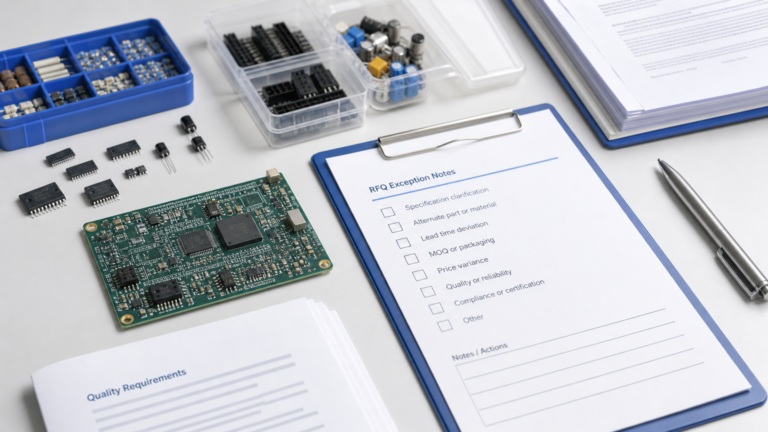
For each group, buyers should confirm current quotes, supplier availability, approved alternates, lifecycle status, and documentation requirements. If the design team has not already approved second sources, the review should flag which alternates need electrical or mechanical validation before they can be used in a live buy.
The right response is not a blanket buy-ahead. It is a timed quoting discipline: exact MPNs, approved manufacturers, substitute evidence, forecast window, date-code expectations, and quality requirements ready before the next production buy is compressed.
What this means for PCX buyers
PCX works with buyers who often need more than a search result for a hard-to-find line through processes such as the PCX Star Quality Program. MLCC pressure is a good example: the sourcing question is not only whether a capacitor exists, but whether the available part fits the electrical requirement, documentation requirement, and risk tolerance of the build.
If your BOM includes AI-exposed, high-reliability, or long-life capacitor lines, share the exact part list and approved-source requirements with PCX while there is still time to check quotes, traceability, and alternates in sequence rather than all at once. A disciplined review can identify where alternates are already usable, where engineering sign-off is needed, and where traceability should take priority over speed.