Broadcom Wireless Silicon Signals Put RF And Networking IC Files On The Buyer Checklist
Not every connectivity headline becomes a purchasing problem. The useful buyer question is narrower: which RF, wireless, switch, FPGA, controller, PHY, retimer, or logic-device lines in the BOM are so tied to package, firmware, layout, customer approval, or supplier choice that a late sourcing change would be slow?
That question is timely because a fresh Broadcom signal is now visible. Evertiq reported on July 9 that Apple announced a multiyear Broadcom commitment for custom silicon components and advanced wireless connectivity technologies. Separately, TrendForce’s public AI-networking analysis describes how switch ICs, Ethernet, InfiniBand, co-packaged optics, silicon photonics, laser sources, and optical modules are becoming more important in scale-out data-center architectures.
The point is not that every networking IC is constrained. The point is that connectivity silicon is a strategic design area. Buyers should know which exact MPNs are standard replenishment items and which ones are locked by technical or commercial conditions before the next quote window changes.
What this means for PCX buyers
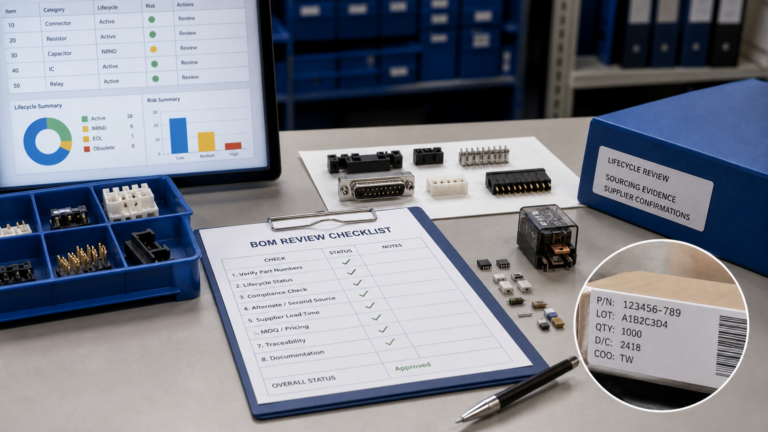
For PCX customers, the risk is rarely the headline itself. It is the delay that appears when a quote changes and the sourcing file is incomplete. RF filters, wireless connectivity ICs, switch devices, programmable logic, timing parts, PHYs, and retimers can carry hidden constraints: customer AVL limits, board-layout dependencies, firmware or configuration notes, test history, date-code limits, packaging requirements, and traceability expectations.
A buyer who has that file ready can evaluate options calmly. A buyer who has only an MPN and quantity may lose time while engineering, quality, and procurement reconstruct the requirements under pressure.
The RF and networking signal
Evertiq’s July 9 article says Apple’s new agreement with Broadcom is expected to exceed USD 30 billion and lead to production of more than 15 billion US-made chips. The same report says the agreement will support expansion and modernization at Broadcom’s Fort Collins, Colorado facilities through a USD 1.5 billion capital expenditure investment.
The article also says Broadcom will produce advanced radio-frequency components, including FBAR filters, and advanced wireless connectivity technologies at the Fort Collins facility. That is a current, public signal around custom silicon and connectivity manufacturing. It does not say buyers should assume allocation. It does say RF and wireless connectivity parts deserve better sourcing documentation than “same as last buy.”
TrendForce adds a different kind of context. Its public analysis says NVIDIA’s InfiniBand has long dominated scale-out AI data-center networks, while Ethernet networks are regaining competitiveness after the UEC 1.0 standard release in June 2025. It also describes Broadcom’s switch-IC bandwidth development, 1.6 Tbps and higher transmission rates, and co-packaged optics as power and latency bottlenecks push network architecture forward.
Where alternates become difficult
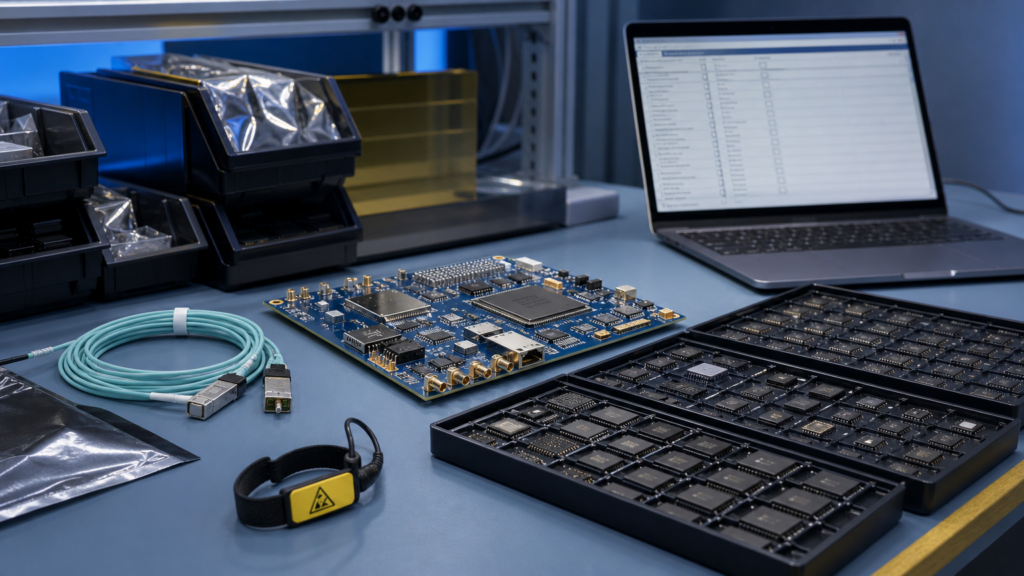
This article is not a repeat of a connector or optical-interconnect BOM review. The focus is the silicon and control layer behind connectivity: RF components, wireless devices, switch ICs, FPGAs, CPLDs, PHYs, retimers, timing parts, controllers, and logic devices. Those parts can be hard to replace because the approved option is often embedded in design assumptions.
An alternate may require a board spin, firmware change, signal-integrity review, thermal check, regulatory review, customer approval, or a new test record. That does not make alternates impossible. It means procurement should avoid discovering those dependencies only after a preferred quote disappears or a supplier asks for a different delivery window.
What to check before the quote cycle
- Which RF, wireless, switch, programmable-logic, PHY, retimer, timing, or controller MPNs support the next two build windows?
- Which lines have approved alternates on paper, and which alternates have actually cleared engineering, quality, and customer review?
- Where do firmware versions, configuration files, board layout, power, thermal, or signal-integrity assumptions limit substitution?
- Which parts require specific date-code, packaging, traceability, certificate, or inspection expectations?
- Which quotes are old enough that current availability, lead time, or minimum-order assumptions should be refreshed?
This checklist is deliberately part-level. Broad market signals are useful only after they are translated into exact sourcing constraints.
What buyers should not assume
Do not treat the Apple-Broadcom commitment as proof of broad RF or networking IC shortage. Do not assume an AI data-center Ethernet trend automatically affects an industrial communications board, medical device, aerospace assembly, or legacy embedded system. Do not claim a part is exposed simply because the supplier name appears in the news.
The safer approach is to use the signal as a review trigger. If the part is easy to source through approved channels and has qualified alternates, it can remain in normal replenishment. If the part is locked by design, customer approval, firmware, or documentation, it deserves earlier RFQ work and clearer forecast visibility.
PCX market insight
PCX’s role is to help buyers connect market signals to exact MPN decisions. For RF and networking ICs, a useful sourcing request includes the approved manufacturer list, acceptable alternates, application constraints, firmware or configuration notes, date-code limits, packaging expectations, and traceability requirements.
That information helps separate a workable quote from a quote that creates hidden qualification or quality risk. It also helps the buyer decide whether a scheduled-order discussion, alternate search, or documentation review is warranted before urgency narrows the choices.
Forecast, RFQ, or BOM review next step
If a connectivity-related line is critical to the build, review it before the next purchasing window. Keep stable, multi-source items in normal replenishment. Move design-locked, customer-controlled, or documentation-heavy lines into earlier RFQ and alternate-review work.
Share the part list or request sourcing support from PCX when an RF, networking IC, FPGA, or logic-device BOM needs exact-MPN review. For sourcing discipline under tighter market conditions, see the PCX Star Quality Program and the integrated circuits category.