Power Discrete Cross-References Need an Evidence File Before the Buy
When a MOSFET, Schottky diode, TVS device, rectifier, transistor, or other power discrete becomes harder to source, the first question is often whether a cross-reference can keep the build moving. That is a reasonable question. It is also an incomplete one.
A cross-reference may point to a possible substitute, but it does not prove electrical fit, package compatibility, thermal margin, qualification status, date-code acceptability, or open-market risk. In a tighter sourcing window, buyers need an evidence file before the purchase order, not just a list of alternate part numbers.
What changed
Electronic Design reported on July 7 that Infineon opened a Dresden Smart Power Fab to expand power semiconductor, analog, and mixed-signal capacity for AI, automotive, industrial, and energy applications. That is a capacity signal, not a near-term availability promise for any exact MPN.
Evertiq reported, citing TrendForce, that mature-node foundry pressure is being shaped by demand for power management ICs and power discrete components, with many of those products still tied to 8-inch manufacturing processes. The same report describes a market where utilization and pricing pressure can move as capacity is reallocated and customers qualify alternatives.
That does not mean every power discrete line is unavailable. It does mean that a buyer should be careful about treating a family-level signal as permission to make a fast substitution. If the original MPN sits in a power path, protection circuit, motor-control board, industrial controller, charging system, or server power stage, the alternate question needs more than a catalog match.
What this does and does not mean
The safe takeaway is narrow: pressure around mature-node and power-discrete supply can increase the value of documented alternates, but it does not remove the need for engineering and quality review. A second-source option can help only if the application can accept it and the sourcing channel can support traceability.
This is where cross-references can mislead busy teams. A part may share voltage and current ratings while differing on package dimensions, avalanche rating, reverse recovery behavior, gate charge, thermal resistance, qualification grade, termination finish, moisture sensitivity, or manufacturer lifecycle status. Those differences can matter more than the headline rating when a design is already released.
What this means for PCX buyers
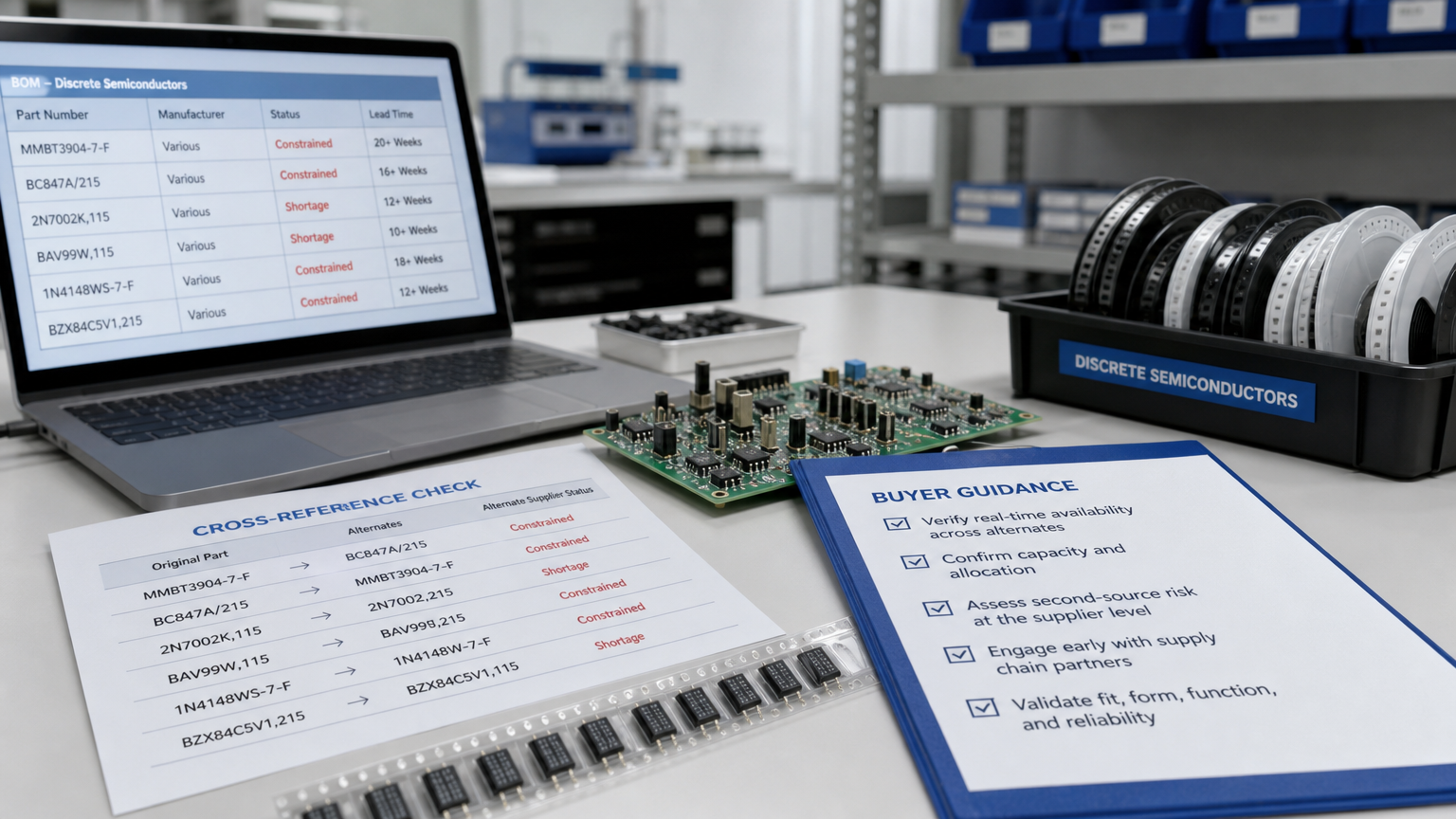
For PCX buyers, the practical step is to separate three files that often get mixed together: the BOM file, the approved-alternate file, and the sourcing-risk file. The BOM identifies the requested MPN. The alternate file records which substitutions engineering has already reviewed. The sourcing-risk file captures where urgency, channel choice, date code, packaging, or documentation creates additional checks before acceptance.
That structure helps a buyer ask better questions when sending an RFQ for discrete semiconductors. Is this a hard MPN, an approved alternate, or a candidate alternate? Is the application switching, rectifying, clamping, protecting, or passing load current? Does the line have automotive, industrial, safety, or customer-specific approval requirements? Is a newer package acceptable, or does the board require an exact footprint?
Which BOM items deserve review
Start with power discretes that combine sourcing exposure with application sensitivity. MOSFETs in power conversion, motor control, battery management, hot-swap, or load-switching roles deserve attention. So do TVS and ESD protection parts tied to connector interfaces, Schottky diodes in high-efficiency power paths, bridge rectifiers and recovery diodes in AC/DC stages, and small-signal transistors that have been on a design for many years.
The review does not have to assume a shortage. It should ask whether the line has a documented second source, whether the approved manufacturer list is current, whether the design owner has already rejected certain substitutes, and whether prior purchases relied on a distributor or broker channel that may not be repeatable.
What procurement should verify before buying
A useful power-discrete evidence file should travel with the RFQ. At minimum, it should include the requested MPN and manufacturer, acceptable manufacturers, package and footprint constraints, electrical parameters that cannot move, thermal assumptions, end-customer approvals, required certifications or grades, target quantity, acceptable date-code range, packaging format, and any prior nonconformance history.
It should also include the sourcing controls. Electronics Sourcing has warned that shortage conditions increase the importance of anti-counterfeit strategies, supplier qualification, inspection, testing, and documentation. For hard-to-find power discretes, that means urgency should raise the verification bar. It should not make buyers accept vague photos, incomplete traceability, or an alternate that has not been reviewed.
Where PCX can help
PCX can be most useful when the buyer provides the evidence file early: exact MPNs, approved alternates, application notes, date-code rules, quality requirements, and timing. That gives a sourcing partner enough context to search responsibly, flag questionable substitutions, and route risk questions back before the build schedule forces a rushed decision.
If a power-discrete line is moving from a normal replenishment item to a risk item, send the details before the only remaining options are urgent. PCX can help buyers request sourcing support while keeping the PCX Star Quality Program and documentation discipline in the conversation.