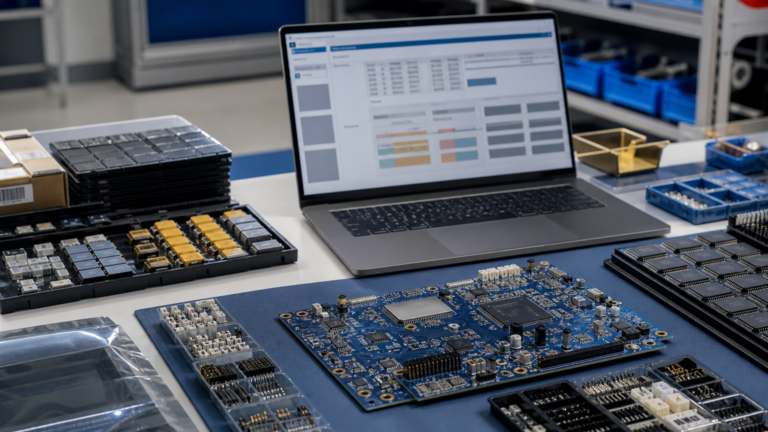
End-of-life notices rarely arrive at a convenient time. For many buyers, the harder problem is that lifecycle, allocation, and counterfeit risk now show up together: a part approaches EOL, normal channels tighten, alternate approvals take time, and urgent spot buys can expose the program to sourcing risk.
What this means for PCX buyers
That is why a midday sourcing review should not treat IP&E, connectors, and passives as background items. Recent Electronics Sourcing coverage on obsolescence and continuity planning points to a practical pattern: buyers need earlier lifecycle visibility, a wider view of the assembly, and tighter evidence around any non-routine source.
Why lifecycle risk is showing up earlier in the buy
Electronics Sourcing reports that component product lifecycles continue to shorten as OEM demand for higher performance pushes component manufacturers to advance architectures and balance manufacturing capacity across broader markets. The same article says downstream teams can face end-of-life notifications, longer lead times, and redesign-cycle timing as a result.
For purchasing teams, the important takeaway is not that every component is suddenly constrained. It is that a lifecycle review belongs earlier in the RFQ process, especially for long-running industrial, medical, aerospace, defense, and infrastructure products. A part can still be purchasable today while becoming harder to support across the next service interval.
A useful review starts with simple questions: which parts have a single approved source, which have no qualified alternate, which sit on boards that cannot be redesigned quickly, and which have date-code, traceability, or environmental requirements that reduce practical supply?
Look at the assembly, not just the line item
The same discipline applies to interconnect and electromechanical content. Electronics Sourcing says many naval and shipboard interconnect products sit within build-to-order supply models where minimum order quantities and lead times do not always align with program timing. It also notes that buyers may need to look beyond a cable family to the wider interconnect path, including connectors, backshells, tubing, and related installation materials.
That broader view is useful outside naval programs as well. A connector substitution can affect mating hardware, tooling, sealing, vibration tolerance, cable routing, approvals, and installation labor. A relay, switch, fan, heatsink, or power-supply change can introduce similar knock-on work. The sourcing question is therefore not only whether a part number can be found. It is whether the assembly can still be built, tested, and supported without creating a new qualification problem.
For buyers working through connector availability or electromechanical component exposure, the practical file should include the approved part, approved alternates, mating or dependent items, critical specifications, expected build schedule, and any traceability or inspection requirements.
Continuity planning is different from panic buying
Electronics Sourcing says modern obsolescence is increasingly influenced by economics, geopolitical volatility, wafer-allocation priorities, and shifting technology investment rather than age alone. Another point from the same article is especially relevant for buyers with long-life products: systems in aerospace, industrial automation, and medical technology may remain deployed for decades while supporting technologies can face supply instability within a few years.
The response should be deliberate. Continuity planning can include strategic stocking, bonded inventory programs, long-term storage, and tailored last-time-buy management, according to Electronics Sourcing. But those tools work best when tied to real demand, approved alternates, storage conditions, and redesign timing. Buying too much of the wrong revision, package, date code, or quality level can create a different inventory problem.
A strong review separates four decisions: what must be bought now, what should be scheduled, what needs engineering qualification, and what should simply be monitored. This is where a scheduled-order review can help without becoming a blanket buying rule.
Counterfeit controls need to be part of the sourcing plan
Lifecycle and shortage pressure can also change the risk profile of the source. Electronics Sourcing says end-of-life notices and shortages can compound counterfeit risk in the electronic component industry. The publication describes AS5553 as a standard for counterfeit electrical, electronic, and electromechanical parts avoidance, detection, mitigation, and disposition, with practices that include supplier evaluation, traceability to the original component manufacturer, inspection and test protocols, flow-down requirements, and quarantine/reporting of suspect counterfeit parts.
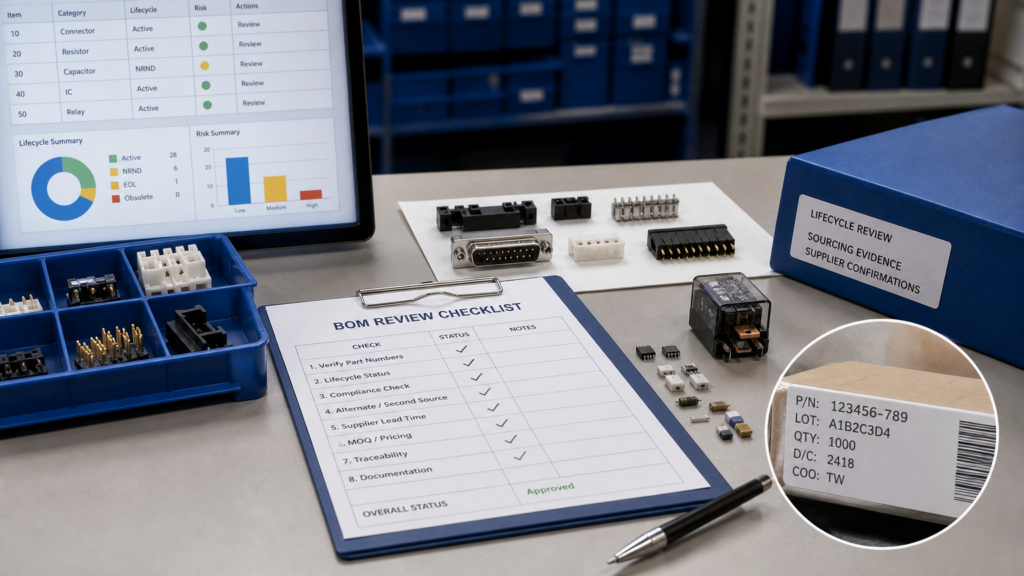
PCX should not be positioned as a substitute for a customer’s internal quality system, and no sourcing partner should promise risk-free procurement. The useful buyer action is narrower: define what evidence must accompany a non-routine buy before the purchase order is placed. That may include traceability expectations, photos, lot/date-code information, inspection steps, test requirements, packaging review, and escalation rules for anomalies.
When counterfeit risk is part of the sourcing conversation, PCX’s STAR quality program is the more relevant internal link than a generic availability message. It keeps the discussion focused on process, documentation, and risk reduction rather than unsupported assurances.
A practical midday checklist for buyers
Use this review when a BOM contains long-life products, legacy semiconductors, specialized connectors, passives under technical pressure, or electromechanical items that are difficult to requalify:
- Identify single-source, sole-approved, and no-alternate line items.
- Check lifecycle status, last-time-buy exposure, and any known EOL notices before the RFQ is urgent.
- Map dependent items such as mating connectors, backshells, cable, hardware, thermal parts, firmware, or test fixtures.
- Separate immediate buys from scheduled releases, strategic stock, engineering qualification, and monitor-only items.
- Define the evidence needed for any open-market or non-routine source before approving the purchase.
- Keep engineering, quality, and procurement aligned on alternates so a purchasing fix does not become a field-support issue.
If a current BOM has hard-to-find passive, connector, electromechanical, or legacy semiconductor lines, PCX can help review availability signals and sourcing evidence before the buy becomes time critical. Start with a focused parts request that includes manufacturer part numbers, approved alternates, target quantities, date-code requirements, and any traceability or test expectations.