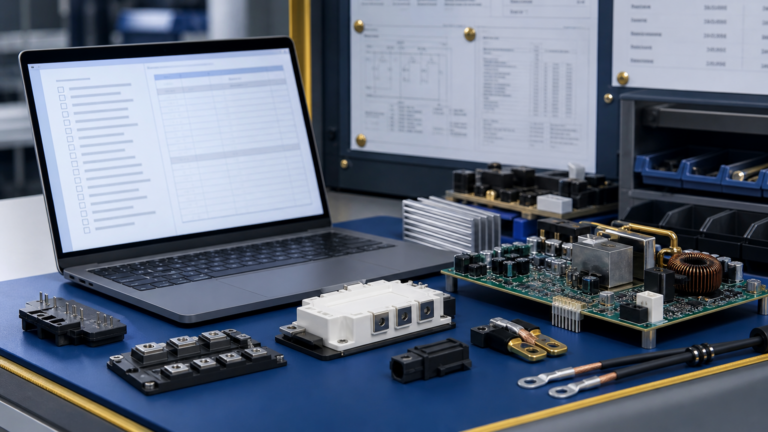
Power semiconductor headlines can be useful without being predictive. The latest example is LTSCT’s agreement with Azuremoto around silicon carbide power devices. For procurement teams, the practical point is not to infer immediate availability, pricing, or capacity from one collaboration announcement. The useful move is narrower: identify which SiC MOSFETs, diodes, power modules, gate-driver-adjacent parts, and board-level power-stage items depend on qualification details that may not be visible in a short headline.
The signal worth separating from the assumptions
Evertiq reported on July 10, 2026 that LTSCT and Azuremoto announced a memorandum of understanding tied to silicon carbide and power semiconductor products. LTSCT also lists a July 2026 press release on the agreement through its public press-release page. Those are real signals, but they do not by themselves answer buyer questions about part-level lead times, substitute approval, last-time-buy risk, or quote durability.
That distinction matters because SiC sourcing is rarely a generic commodity decision. A BOM may call out a package, voltage class, thermal profile, switching behavior, isolation approach, or module-level mechanical boundary that limits how quickly alternates can be evaluated. If a purchasing file says only “SiC MOSFET” or “power module” without the engineering approval notes beside it, a supplier-development headline can create more confusion than clarity at RFQ time.
Why SiC sourcing files need more than a headline
SiC devices often sit near other sensitive line items: power-management ICs, gate drivers, current-sense parts, connectors, heatsinks, thermal interface material, relays, and protection components. A sourcing change in one power device can ripple into test coverage, thermal derating, board layout assumptions, and documentation for the end customer. That is why procurement should treat a collaboration signal as a trigger for file hygiene rather than a shortcut to a buying conclusion.
For active builds, the review should begin with exact manufacturer part numbers and approved manufacturer lists. Check whether the BOM distinguishes between discrete semiconductors and module-level assemblies, whether engineering has named acceptable alternates, and whether the quality file includes packaging, date-code, lot-traceability, and inspection requirements. A collaboration may eventually broaden the supplier landscape, but the current purchase decision still rests on approved parts and documented substitutions.
Qualification notes buyers should check first
The most useful sourcing review is deliberately specific. Start with the SiC device lines that carry the highest operational consequence: traction, charging, inverter, industrial power conversion, energy storage, high-current motor control, and similar power paths. Then verify whether the buying team has current drawings, approved-source notes, lifecycle status, and any customer-specific approval requirements.
Next, separate three questions that are often mixed together. First, is the exact part available through a trusted channel? Second, is an alternate technically qualified, including package, thermal, and switching behavior? Third, is the commercial quote aligned with the forecast window and budget assumptions? A single news signal cannot answer all three. It can, however, remind the team to prepare the evidence before a shortage, price move, or expedite request forces the issue.
What this means for PCX buyers
For PCX buyers, the sourcing angle is straightforward: keep SiC and adjacent power-stage components attached to their approval evidence. PCX can help review sourcing options for discrete semiconductors, adjacent power-management ICs, and board-level support parts when the buyer provides exact MPNs, alternates under consideration, and any quality or traceability requirements.
This is especially important where the same assembly includes older silicon devices, newer SiC devices, and support components with different lifecycle profiles. A sourcing team may be able to find inventory for one line item while another part requires alternate review or documentation cleanup. Treating the whole power stage as a single availability problem hides those differences.
A measured sourcing response
The measured response is not to panic-buy SiC parts because a collaboration was announced. It is to make the next quote package cleaner. Buyers should identify exposed SiC lines, confirm approved manufacturers and alternates, check whether forecast demand is visible far enough ahead, and flag any lines where engineering approval would slow a substitution. If the file is incomplete, fix that before the next urgent RFQ.
When a BOM review turns up exact-MPN exposure, share the part numbers, manufacturer preferences, target quantities, date-code restrictions, and quality requirements through the PCX parts request form. That gives a sourcing partner enough context to distinguish ordinary purchasing work from lines that need quality, lifecycle, or alternate-source attention.