AI Memory Pressure Is a Cost-Driver Signal for Board-Level Buyers
Memory pricing headlines are becoming a practical sourcing signal again. The useful question for electronics buyers is not whether every board-level component is suddenly constrained. It is which BOM lines have memory exposure, where AI-infrastructure demand may be competing for supply, and which alternates or sourcing windows need to be checked before the next build window tightens.
Two current public signals point in the same direction. Supply Chain Connect reported on June 9 that the AI data center boom is increasing demand for high-bandwidth DRAM, contributing to shortages and price hikes. TrendForce’s public memory-wall analysis also frames AI compute demand as a driver of a memory supercycle, with DDR5 and HBM called out in its public page text. Those signals are strong enough for procurement attention. They are not enough to claim universal allocation, fixed lead-time movement, or price changes for any exact MPN on a live BOM.
What the current signals say
Supply Chain Connect’s June 9 article, “Memory Chip Shortage Drives Up Electronics Prices,” says DRAM chips are becoming harder to find and more expensive as AI data centers consume more of the global memory supply. Its visible key highlights say the AI data center boom is significantly increasing demand for high-bandwidth DRAM, causing shortages and price hikes. The same article states that automakers, retailers, and technology companies are raising concerns over supply chain disruption and rising costs tied to DRAM scarcity.
TrendForce’s public “Memory Wall Bottleneck” page uses a similar direction of travel, describing AI compute as sparking a memory supercycle. The public page text says AI is driving a memory supercycle, that DDR5 prices are rising, and that HBM3e orders are pushing the market higher. It also says that HBM demand is affecting supply for consumer DRAM and extending impact to the consumer electronics market.
A separate Supply Chain Connect article on the 2026 supply environment widens the lens. It argues that AI-infrastructure shortages run deeper than the chip and describes constraints spreading beyond semiconductors into substrate materials, power components, optics, and thermal infrastructure. PCX treats that article as a useful supply-chain interpretation source, not as proof of a specific part-level lead time unless a buyer can confirm the exact component family, manufacturer, package, and channel.
Where cost pressure can reach a BOM
For many PCX customers, the first exposure is not an HBM stack inside a data-center accelerator. It is a production board that still depends on DDR, LPDDR, NAND, embedded storage, controllers, power-management ICs, MOSFETs, connectors, passives, thermal parts, or electromechanical items that share capacity, substrate, material, or build-schedule dependencies with higher-growth demand areas.
That is why broad memory headlines should be translated into BOM-specific questions. Is the design using a memory device with limited approved alternates? Is the approved vendor list narrow? Are there older NAND, DRAM, or embedded-memory parts with lifecycle risk? Are the memory device, controller, and power tree qualified together in a way that makes substitution harder? Are contract manufacturers asking for earlier coverage because their own allocation conversations are changing?
The answer may be different by program. A stable industrial board with approved inventory and a long-view schedule may only need monitoring. A product entering a build window with single-sourced memory, a narrow package requirement, or an end-customer date commitment deserves a deeper sourcing review.
What this means for PCX buyers
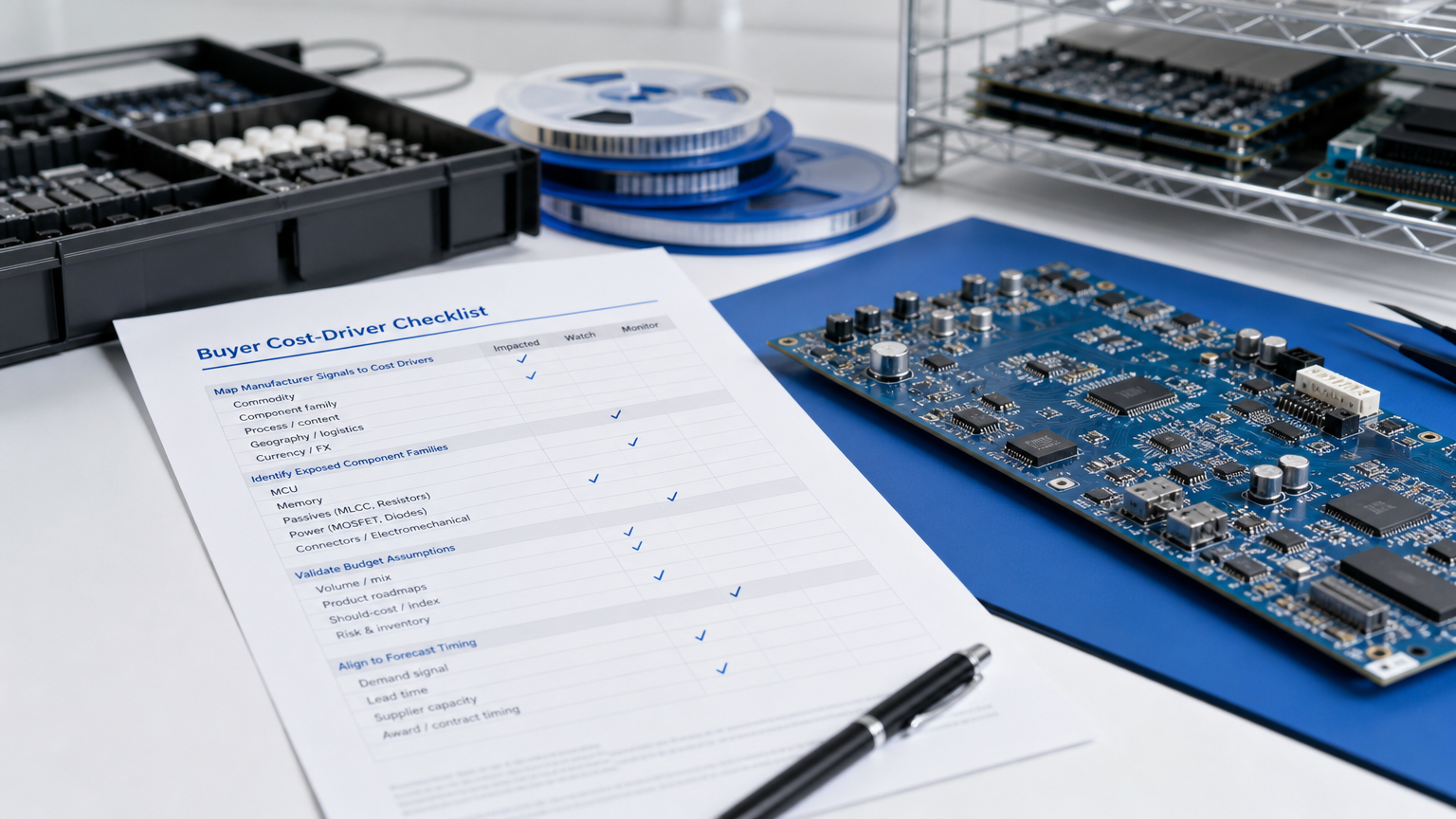
For buyers sending PCX an RFQ or BOM review, the practical response is to flag memory-bearing lines early and avoid waiting until a spot quote becomes the only option. Share exact manufacturer part numbers, acceptable date-code rules, target quantities, required delivery windows, approved alternates, country-of-origin constraints, and any test or traceability documentation the program requires.
PCX can help buyers separate three different issues that often get blurred during price-pressure cycles: whether a part is actually constrained, whether the quoted channel has trustworthy inventory, and whether the program can safely approve an alternate. Those are different decisions. A higher-priced offer is not automatically the right offer, and a lower-priced offer is not useful if traceability, condition, or documentation does not meet the program’s risk standard.
For memory-heavy assemblies, buyers should also look beyond the memory line itself. Review the related power-management ICs, discretes, connectors, passives, sockets, thermal hardware, and embedded-controller dependencies that could become the real schedule limiter after the memory issue is solved.
What not to assume from market headlines
Do not assume that a memory supercycle headline means every memory component is unavailable. Do not assume that a shortage signal applies equally to HBM, DDR5, LPDDR, NAND, eMMC, industrial storage, or legacy memory. Do not assume that price pressure in one segment proves allocation in another. And do not assume that open-market availability is acceptable without source, condition, and documentation review.
The safer reading is narrower: AI infrastructure is a demand signal that can pull attention, capacity, and material availability toward memory and related board-level ecosystems. That can affect sourcing strategy, but it still has to be confirmed at the exact-part level. This is especially important when older memory devices, last-time-buy exposure, or customer-approved alternates are involved.
Buyer actions for the next sourcing review
Start with the BOM lines that would stop production if a supplier pushed out delivery. Mark memory, storage, controller, power, and thermal items with limited alternates. Ask suppliers whether current quotes are supported by documented inventory, incoming factory supply, or brokered open-market availability. Reconfirm whether the engineering team can approve second sources before the build window, not after a shortage becomes visible.
For constrained or high-value lines, keep quality discipline in the sourcing file: lot information, chain-of-custody documentation where available, inspection expectations, test requirements, packaging condition, and date-code acceptance. If the program cannot accept older date codes or mixed lots, say that at RFQ time. If it can accept them after review, define the approval path before a purchase decision is urgent.
The sourcing takeaway is measured but clear: memory-pressure signals are no longer background noise for board-level buyers. Treat them as a prompt to tighten the BOM file, not as a reason to make unsupported market-wide assumptions. If you have memory-bearing or AI-adjacent component exposure, send PCX the parts list so the sourcing review can focus on exact MPNs, documentation, alternates, and schedule risk.