Electronic Design’s July product note on Vishay power MOSFETs is not a market shortage story, and it should not be treated as one. It is a useful buyer-watch signal for a narrower reason: motor-control sourcing files often fail at the point where electrical performance, EMI behavior, package choice, and approved-alternate boundaries meet.
What this means for PCX buyers
For procurement teams supporting drives, robotics, HVAC controls, pumps, industrial automation, or vehicle-adjacent motor-control boards, the practical question is not whether a newly highlighted MOSFET family changes the whole market. The question is whether the quote package for an existing design is specific enough for a sourcing partner to search responsibly without turning an engineering choice into a risky substitution. If your team is reviewing discrete semiconductors, the first step is making sure the non-negotiable electrical and approval boundaries are visible.
The signal: noise behavior belongs in the sourcing file
Electronic Design described Vishay 40-V MOSFETs aimed at preventing false triggering and suppressing noise in motor-control circuits. That is a design-performance claim about a product family, not evidence of allocation, price movement, or broad availability pressure. PCX is treating it as a documentation prompt for buyers who already have MOSFET lines on active BOMs or approved-alternate lists.
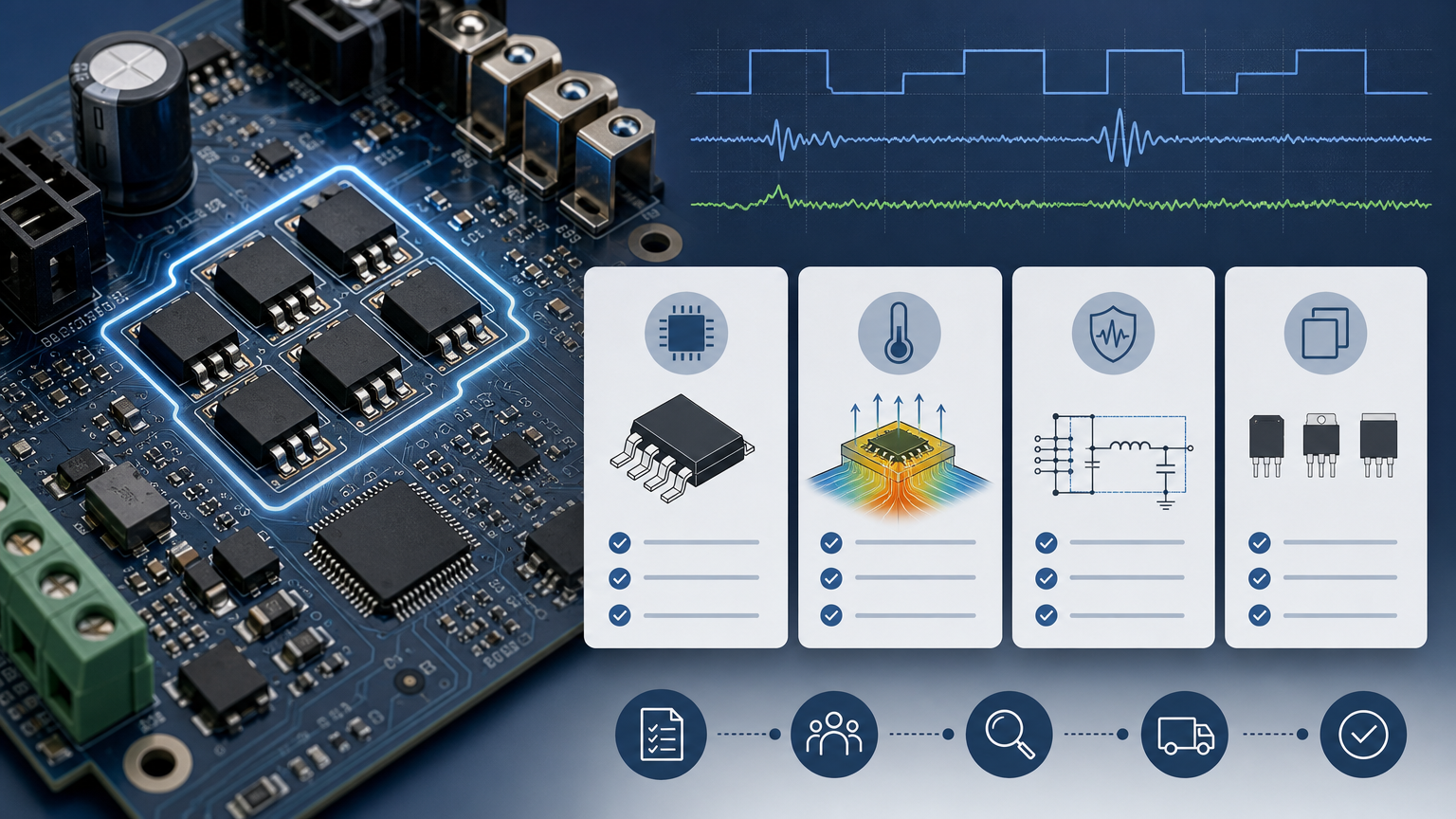
Noise and false-triggering language matters because MOSFET alternates are rarely interchangeable on package and current rating alone. Gate behavior, switching conditions, thermal margin, board layout, and EMI sensitivity can all affect whether a candidate part is acceptable in a real motor-control design. When a sourcing request says only “40-V MOSFET” or provides a partial description without application context, the search may produce parts that look close in a table but still require engineering review before purchase.
What buyers should add before requesting alternates
A useful RFQ for a motor-control MOSFET should include the exact manufacturer part number, package, current and voltage requirements, thermal constraints, preferred manufacturer list, and the approval status for any already-qualified alternates. If EMI or false-triggering behavior is relevant to the board, say so directly. The sourcing team does not need proprietary design files, but it does need enough context to avoid treating a noise-sensitive switching component like a generic commodity line.
Procurement should also note whether the request is for production continuity, a prototype build, a repair program, or an engineering evaluation. Those use cases tolerate different levels of substitution risk. A prototype team may be able to test a suggested alternate. A production buyer supporting a released motor-control assembly usually needs tighter evidence before accepting any cross-reference.
Where sourcing risk can appear
The risk in this type of buyer-watch item is not that a single product note proves a supply constraint. It does not. The risk is that a rushed search for MOSFET availability can strip away the very details that made the original design stable: package parasitics, gate-drive assumptions, switching behavior, thermal derating, and board-level EMI limits.
That is especially important when open-market sourcing enters the conversation. If an approved part is difficult to locate, buyers may be tempted to widen the search quickly. The safer approach is to separate three tasks: first, locate traceable stock for the approved MPN; second, verify documentation and handling for any offered inventory; and third, route any alternate candidate through engineering before it is treated as production-ready.
How PCX would frame the RFQ
For a MOSFET line tied to motor control, PCX would ask for the approved manufacturer part number, the required package and quantity, date-code preferences if any, target build date, and any constraints around substitutions. If the buyer is open to alternates, the RFQ should say who can approve them and what evidence is required: datasheet comparison, package match, thermal check, qualification status, or prior AVL history.
Quality controls belong in the same file. Buyers should request traceability and inspection discipline before accepting urgent stock, especially when the sourcing path moves outside routine channels. That does not remove engineering review, but it reduces the chance that schedule pressure lowers the sourcing standard.
The buyer takeaway
Use the Vishay MOSFET signal as a reminder to clean up motor-control quote notes before availability becomes urgent. A good sourcing file does not need to overexplain the design, but it should tell a sourcing partner which characteristics cannot move. For noise-sensitive MOSFETs, those boundaries may include more than voltage, current, and package.
If your team is reviewing MOSFETs, power switches, or other discrete semiconductors for a current build, PCX can help structure the search around exact MPNs, approved alternates, documentation needs, and traceability expectations. You can request sourcing support with the exact part numbers and approval boundaries your team needs checked. That keeps the sourcing conversation practical: find supply where it is available, but do not turn a board-level performance issue into an unchecked substitution.