
Solid-State Relay Quotes Need Load, Isolation, and Thermal Notes
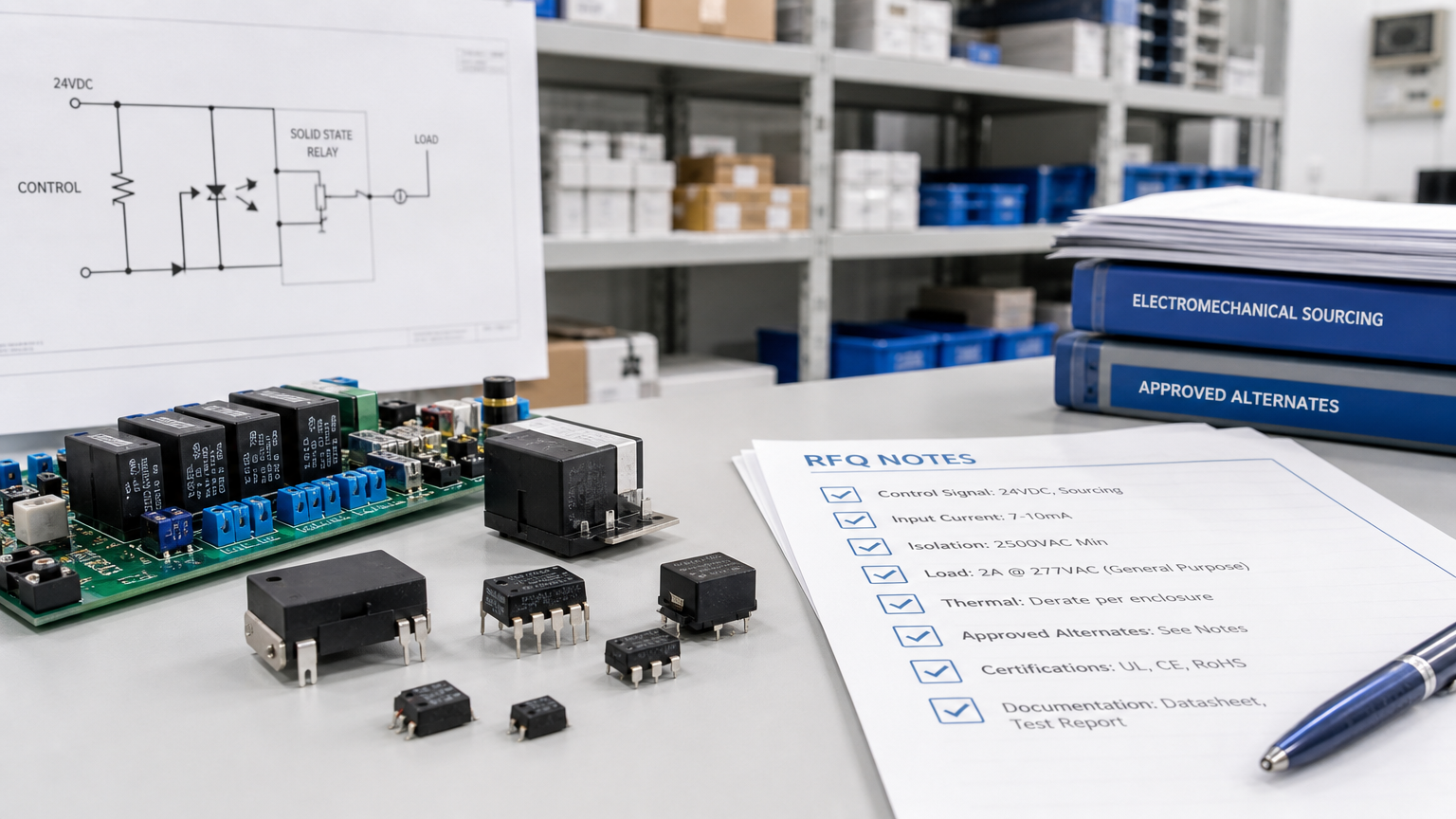
Solid-state relays can look simple from the purchasing side because the line item often arrives as one manufacturer part number. In a controls build, though, that part number carries a set of application assumptions: what load is being switched, how the input is driven, how isolation is handled, where heat goes, and which approvals or mounting constraints matter. Those details should not stay only in the schematic.
A recent Electronic Design sponsored infographic from Littelfuse discusses solid-state relays in building automation applications such as HVAC, lighting, and energy management. For buyers, the useful takeaway is narrow: an SSR quote request should carry the application constraints that make one relay acceptable and another relay only superficially similar.
The component choice behind the quote
An SSR is not only a relay label. It is an output component selected for a control function, a load, and an installation environment. Electronic Design’s article points to attributes such as optical isolation, low-input current, and load-powered configurations. Those phrases are helpful because they show the kinds of variables engineering may have considered before the part reached purchasing.
The buyer’s job is to preserve those variables through the sourcing process. If the part is exact-only, the request should say so. If engineering will review alternates, the request should define which variables cannot move. That distinction keeps a quote request from becoming an uncontrolled cross-reference exercise.
What this means for PCX buyers
For PCX buyers, the practical question is not whether SSR demand is rising or falling. The inspected sources do not support that kind of market conclusion. The practical question is whether the quote request includes enough information for a responsible search across relays, switches, optically isolated outputs, industrial-control assemblies, and related board-level components.
When a control-board part is tied to building automation, HVAC, lighting, or energy-management equipment, the sourcing note should explain the application boundary. Buyers can use PCX’s industrial control component context to frame the category, but the quote still needs the buyer’s own load, package, approval, and documentation requirements. Without that context, a sourcing partner may find availability without knowing whether the option is usable.
Load and switching details to send first
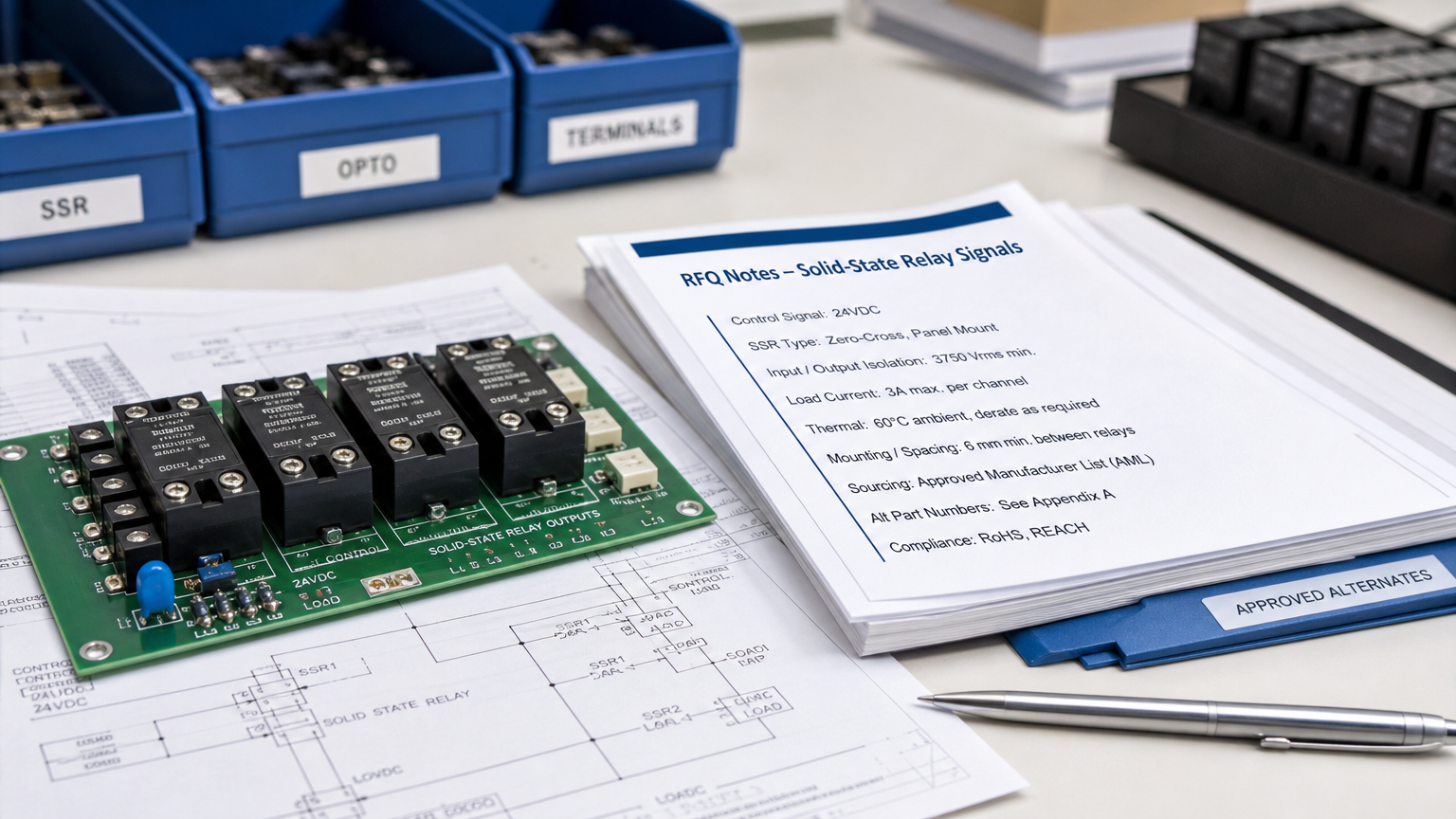
The first group of notes should describe what the relay is doing electrically. Buyers should include the load type, load voltage and current range, whether the circuit is AC or DC, the expected switching pattern, and any known inrush, duty-cycle, or derating assumptions. If the relay is part of an HVAC controller, lighting module, thermostat board, or industrial-control panel, that application context should be included too.
- Exact part number, package, and manufacturer preference.
- AC or DC load, voltage/current range, duty cycle, and load behavior notes.
- Input-control requirements and isolation expectations.
- Mounting style, footprint, terminal arrangement, and board-space limits.
- Thermal conditions, enclosure assumptions, heatsink or airflow constraints, and derating notes.
- Approval, traceability, documentation, and approved-alternate boundaries.
Panasonic Industrial Devices lists solid-state relays within its relays and contactors product structure. That reinforces a useful sourcing point: family labels help organize the search, but they do not prove interchangeability. The electrical and mechanical notes are what make the category useful to purchasing.
Isolation, package, and thermal boundaries
Isolation, package, and thermal fit are where same-family alternates often become harder than expected. A device may be a solid-state relay and still differ in input current, output rating, isolation approach, terminal layout, heat dissipation, or board footprint. Those differences may be acceptable in a new design review; they may be unacceptable in a production replacement.
Buyers should mark which boundaries are fixed and which are reviewable. A thermal change may require engineering signoff. A package change may affect board layout or assembly handling. A different approval file may affect where the finished equipment can ship. These are not reasons to avoid alternates; they are reasons to route alternates through the right review before purchase.
Approval and quality notes that still matter
Quote speed should not erase documentation discipline. The request should state whether the buyer needs traceability records, packaging photos, date-code sensitivity, certificate or approval references, or other inspection notes. For urgent or hard-to-find controls components, PCX’s Star Quality Program is relevant because quality review should stay attached to the sourcing process, not appear only after material is found.
The safe language is also important. A sourcing note should not claim a shortage, allocation event, or price move unless inspected public sources support that claim. In this case, the source-backed point is application fit, not a market-pressure claim. That keeps the article useful without overstating what the sources show.
When an alternate is not a drop-in
An SSR alternate should be escalated when it changes load capability, input requirements, isolation assumptions, thermal behavior, package, termination, manufacturer, agency approvals, or lifecycle posture. It should also be escalated when the production team has already qualified a narrow set of approved sources. Procurement can help identify options, but engineering and quality need to decide whether an option can move from quote to build.
That same discipline applies beyond relays. Connectors, power-management ICs, discrete semiconductors, switches, and other board-level components can all look interchangeable until the application details are inspected. The earlier those details are written down, the less likely the buyer is to waste time comparing quotes that production cannot accept.
Turning notes into a usable quote request
A strong SSR request gives PCX the exact part number, the must-hold constraints, the reviewable constraints, and the desired timing. If alternates are allowed, say who approves them. If the part is locked, say that clearly. If the buyer needs availability support on a control-component BOM line, the best next step is to request a quote with the load, isolation, thermal, mounting, and documentation notes included.
The result is not a slower purchasing process. It is a cleaner one. Sourcing teams can move faster when the quote request makes the real decision visible from the start.